










Bétyle Studio transforms historic French farm building with wood and glass partitions


Local practice Bétyle Studio has transformed a former agricultural building in Marseille, France, into a compact home featuring rooms separated by glass blocks that allow light to filter through.
The client asked designers Carla Romano and Nicolas Cazenave de la Roche to create an interior that could function both as her daily workspace and a private retreat for hosting friends and family.

The agricultural outbuilding, constructed in 1820, is attached to a farmhouse and was originally built from limestone rubble with a traditional timber frame. The total floor area of the living spaces is just 45 square metres.
The owner was attracted by the building's historic character, including its thick, windowless walls that could not be altered without compromising its structural integrity.

"The entire approach consisted of imagining a solution that could bring clarity and fluidity while respecting the agricultural spirit of the building," Cazenave de la Roche told Dezeen.
Bétyle proposed adding an internal wood and glass framework that is set back from the masonry ceiling and walls.

The hollow volume functions as a partition, storage area and light filter that facilitates free circulation around the space and allows natural light to permeate throughout.
"The main constraint was the light, as creating new openings would have weakened the walls," Cazenave de la Roche added.
"We therefore had to reconfigure the interior volumes without touching the existing envelope, and imagine a way to diffuse light throughout the space."

The internal volume defines the office, bedroom and corridor spaces while also incorporating key functional elements, including storage, a dressing room and a desk space.
Sandblasted glass bricks positioned along the edges of the central structure ensure privacy while allowing daylight to pass through and creating a lantern-like effect at night.
The internal structure's walls are made from okoumé wood stained a deep-red shade to complement a ceramic stoneware floor that evokes the patina of traditional Marseille terracotta tiles.
To create a sense of cohesion throughout the project, Bétyle commissioned bespoke furniture, cabinetry, architectural hardware and lighting pieces, including a pendant lamp designed specifically for the office.

"The project relies on a network of craftspeople whose savoir-faire gives depth and authenticity to the final result," said the designers, who collaborated with a team of carpenters, metalworkers and other artisans.
Some of the interior elements recall the building's original agricultural use but have been reinterpreted to fit their new purpose. The stainless-steel bathroom vanity evokes feeding troughs, while farm hooks fixed to the wooden panels now function as hangers.

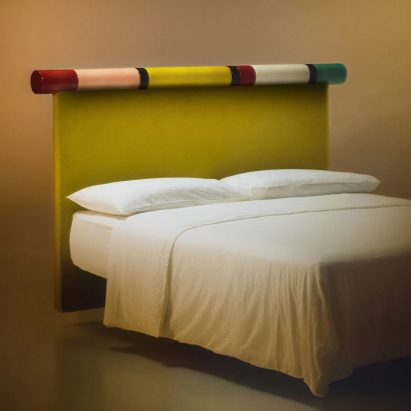
The handmade wooden bed base features an intricate star-shaped inlay pattern that references the studio's name. The baetyl is a sacred stone, believed to be part of a meteorite, that is regarded in some cultures as a symbol of stability and permanence.
"It adds a touch of refinement and anchors the night area within a narrative, somewhere between craftsmanship, symbolism and the studio's architectural identity," added Cazenave de la Roche.

The Figuier residence is Bétyle's first interior project and its fully bespoke design reflects the studio's approach to creating contemporary spaces that display a deep respect for their historical context.
Other projects in Marseille include a bao restaurant by Neri & Hu and an apartment within architect Le Corbusier's iconic Cité Radieuse housing block.
The photography is by Mathilde Hiley.
The post Bétyle Studio transforms historic French farm building with wood and glass partitions appeared first on Dezeen.