







Maternity clinic with cladding to support wildlife among projects from the Royal Danish Academy


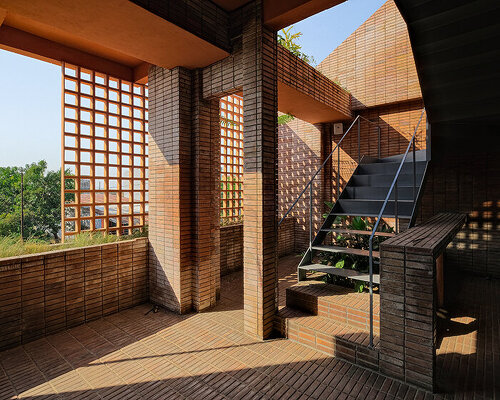
Dezeen School Shows: a maternity clinic in India featuring cladding as a habitat for local birds, insects and spiders is among the projects from the Royal Danish Academy.
Also featured is a speculative design project using AI to explore the future of the fashion industry, and an another using agricultural and food waste to produce new materials.
Royal Danish Academy
Institution: Royal Danish Academy – Architecture, Design, Conservation
Course: Imagining the Future – through Architecture and Design
Tutors: Karin Elisabeth Gottlieb, Charlotte Fischer, Jakob Ion Wille, Christian Lindvang Samsøe and Susanne Jøker Johnsen
School statement:
"What would happen if we dared to visualise a future scenario – not as science fiction, but as tangible, research-based proposals for new ways of living, dwelling and thinking?
"The Imagining the Future exhibition presents 29 projects by architects and designers.
"The projects use current challenges and possibilities as their point of departure: new materials, new ways of dwelling and providing ourselves with shelter, new ways of envisaging community and sustainability.
"In Imagining the Future, designers and architects depict the part they play in shaping the future by examining the present. Keeping in mind our common culture and identity, the exhibition features projects that make the changes in the future attractive.
"Design and architecture are not only about function but also involve fostering meaningful ideas through aesthetics, user involvement and local anchoring. In brief: to understand human needs and reflect this.
"We are at a crossroads where the future can sometimes be hard to imagine but that's something architects and designers are particularly good at. In the exhibition, you'll find tangible solutions as well as critical reflections on the present."

Group project: The Hand of Nature
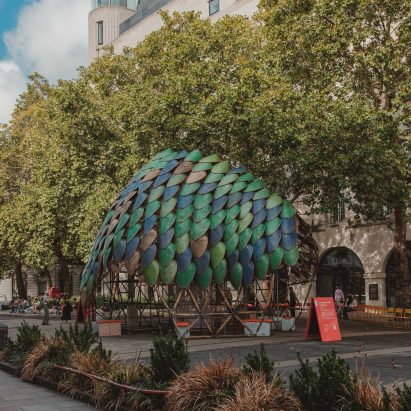
"The Hand of Nature is an architectural study of thatch, straw and cork where artisanal processes converge with the physical properties of the materials. The project explores inherent building techniques and ecological cycles.
"It demonstrates the interconnections between forms of knowledge, conceptual development, technical solutions and aesthetic expression, and how they depend on ethical choices.
"The project was developed in close collaboration with artisans, builders, manufacturers of building materials and the Danish Institute of Fire and Security Technology and put into practice as a 1:1 facade section (three by seven metres) for a multi-storey housing complex."
Students: Anne Beim, Johannes Schotanus, Astrid Juul Jørgensen, Jonatan Møller Larsen and Henriette Ejstrup
Course: CINARK – Center for Industriel Arkitektur, Architecture and Technology

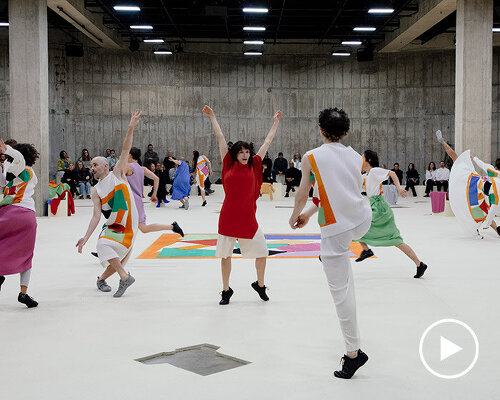
Adaptive Knit by Martin Tamke
"Adaptive Knit envisages a future in which buildings adapt to rising temperatures in a manner that minimises the consumption of resources and maximises aesthetic freedom.
"The installation is a kinetic textile structure created by ribbed, CNC-knitted patterns in natural materials to serve as flexible solar protection without wasting resources.
"An interdisciplinary team of fashion and architectural professionals have developed the project.
"The expanded prototype comprises five panels which react to the surroundings and capture visitors' attention through changing geometrics, colours and textures."
Student: Martin Tamke
Course: Computation in Architecture, Architecture and Technology

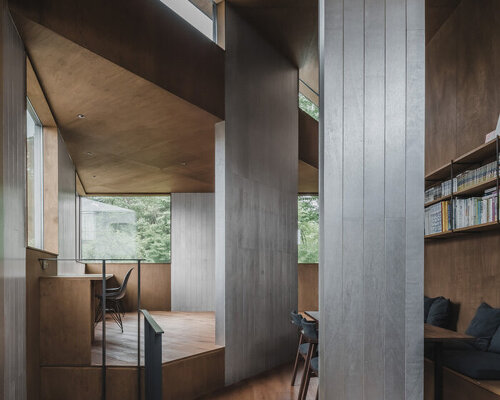
Watershore Habitat by David A Garcia
"The Watershore Habitat is made up of innovative forms of coast defences that blend in with the landscape and establish better living conditions for people living in these exposed areas.
"The project challenges the view of flooding by regarding it as a phenomenon with which people can live in harmony.
"Instead of regarding the water as an enemy, its life-giving potential is incorporated into urban planning.
"The project presents a dynamic architectural outlook comprising a wide range of typologies serving as lifeboats and critical infrastructure."
Student: David A Garcia
Course: Architecture and Extreme Environments, Architecture and Space

Terra Hybrid – Heterogenous Earth Constructions by Frans Drewniak
"The Terra Hybrida project envisions a more hybrid, composite future in which we must use everything we already have at hand, while adding as little as possible.
"The 'Terra' research network examines hybrids of clay soil, unfired bricks and tiles. The Terra Hybrid installation is a Ziggurat, which means 'to protrude, to build high'.
"The Ziggurat dates all the way back to the first temples of sun-dried brick in ancient Mesopotamia.
"It reflects a world of ideas we are familiar with in much of Denmark's best masonry architecture, such as churches designed by Peder Vilhelm Jensen-Klint."
Student: Frans Drewniak
Course: Architecture's Anatomy and Fabrication, Architecture and Technology

Untold Narratives about Mystical Creatures and Peculiar Habitats by Helene Søndergaard Jensen
"Denmark is one of the most cultivated countries in the world and Lumby Strand near Odense is a typical example of Denmark's intensively cultivated farmland.
"Helene Søndergaard Jensen uses embroidery to study how the cultivated soil can fundamentally change by acknowledging the magic in the landscape.
"The project studies future scenarios for Lumby Strand as regenerative agriculture, collective land allotment, new hybrid habitats and political initiatives.
"Thus, the embroidery emerges from tangible ideological and site-specific proposals.
"The practice revolves around a conviction that a re-enchanted perception of the landscape can lead to a more caring form of agriculture."
Student: Helene Søndergaard Jensen
Course: Architecture and Landscape, Architecture, Urbanism and Landscape

Therma Testa by Flemming Tvede Hansen and Isak Worre Foged
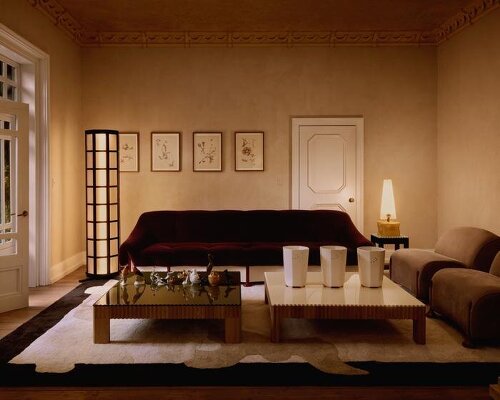
"Therma Testa uses experiments and simulations to work up new architectural concepts by selecting, organising and shaping materials in relation to one another.
"The project studies how tiles can serve as thermally active membranes that store and pass on heat, such as from bathrooms to adjoining rooms, without transferring moisture.
"The tiles combine raw red clay and azurite in an uncompromising form which unites function and aesthetics.
"The project points towards a future in which dwellings are not structured around thermal barriers.
"Instead, the architecture supports an active thermal system that makes the dwelling healthy and pleasant to live in without depleting the planet's resources."
Students: Flemming Tvede Hansen and Isak Worre Foged
Course: Design, Product and Material/Architecture and Space

Fashion Dreaming by Else Skjold and Brian Frandsen
"Fashion Dreaming is a hopeful study of what a future fashion industry that puts the planet first could look like.
"Using speculative design, you can meet seven avatars from various years between 2045 and 2075, explaining how they transformed the fashion industry by implementing planetary considerations into all the processes.
"The stories were created by AI, based on dreams and visions expressed by more than a hundred professionals from our modern fashion industry.
"This is a peek into a circular future where the industry has successfully reformed its responsibility and reduced its footprint."
Students: Else Skjold and Brian Frandsen
Course: Fashion Design and Textile/Visual Game and Media Design/Klothing – Centre for Apparel, Textiles and Ecology Research, Design, Product and Material/Design and Visual Interaction/Business and Innovation

Group project: DesignWise– creating without having a harmful impact
"DesignWise explores what happens if the designer instead approaches the process as a cycle, without primarily seeking to achieve a given goal through each individual choice.
"The project explores the design process itself as a means of creating a connection to ourselves, one another and our shared planet.
"The project builds on a 360-degree approach inspired by a planetary design mindset, systemic leadership and insight from indigenous traditions of wisdom.
"The method is structured around eight phases that provide scope for changing perspectives and allowing the design process to move from the intimate to the planetary sphere; from short-sighted to multi-generational perspectives; from acting to sensing."
Students: Ida Engholm, Christina Reedtz Funder, Brian Frandsen, Lotte Borg and Henriette Melchiorsen
Course: Master in Design, Design and Visual Interaction

Unwasted by Anna Maria Sand Jensen
"Can waste from the agricultural and food industries be converted into new materials that make the construction industry more sustainable and tie closer bonds between architecture, people and the environment?
"The Unwasted project points towards a future in which heaps of waste are transformed into resources.
"With its point of departure in ceramic tiles made of 65 to 100 per cent waste, the project shows how materials can transverse industrial boundaries.
"The project builds on a circular consumption mindset: by using waste as a resource, the waste generated by a factory or farmer can become part of a neighbour's house."
Student: Anna Maria Sand Jensen
Course: Crafts in Glass and Ceramics/Strategic Design and Entrepreneurship, Design, Product and Material/Design and Visual Interaction

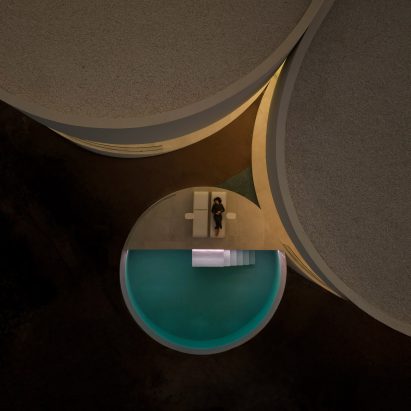
Mothering Nature by Alma Kober Sørensen
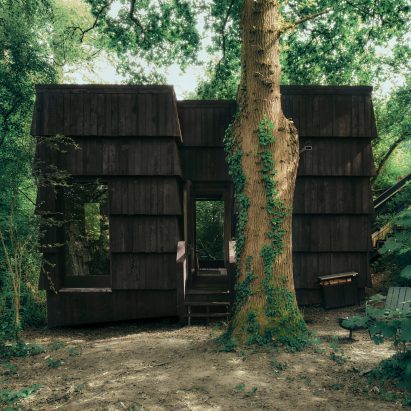
"The Mothering Nature project arose from a field study in the state of Rajasthan, India, where Alma Kober Sørensen has designed a proposal for a maternity clinic.
"Based on a master plan which follows a path trodden by grazing cattle around the maternity clinic, the project studies how architecture can strengthen bonds between people, animals and plants.
"Cladding and roof become habitats for birds, insects and spiders. Children are free to move around, explore and interact with the various species in reciprocal interspecific exchanges.
"Inside the clinic, expectant mothers receive the help they need in peaceful, life-giving surroundings."
Student: Alma Kober Sørensen
Course: Architecture and Extreme Environments, Architecture and Space
Partnership content
This school show is a partnership between Dezeen and the Royal Danish Academy. Find out more about Dezeen partnership content here.
The post Maternity clinic with cladding to support wildlife among projects from the Royal Danish Academy appeared first on Dezeen.