









Case goods suppliers put product first to capture momentum at fall market
At a Glance:
- Elements International reports highest backlog since COVID
- Universal Furniture attracts new partners with brand elevation
- Stickley sees high-end orders refreshing dealer floors
HIGH POINT — The word on the street among case goods suppliers at the recently concluded fall market spoke of real momentum at the luxury and higher-end price points, while the middle market and promotional segments struggled.
But a look beneath the surface-level traffic trends revealed a more complex and cautiously optimistic picture.
Furniture Today’s conversations with companies across the spectrum of price, sourcing model and target buyer showed that willingness to take risks and introduce new product paid off with stronger orders and interest from buyers.
See also:
- High Point suppliers make supply chain solutions part of the pitch
- Warmer finishes, fresh details, accents stood out in case goods at High Point
At a time when rising costs have raised the floor for suppliers and strained many consumers, the crucial question for manufacturers and importers was how to incorporate a sense of value into the products on their floor that went beyond the sticker price.
Traffic trends continue
Earlier arrivals continued to reshape the showroom schedule, but the traffic picture varied by supplier, with some reporting momentum that ran counter to the broader challenges in case goods.
“We had a great market. Our sales are terrific right now. We have our highest backlog since COVID,” said Paul Comrie, CEO of Elements International, adding, “We had customers here Monday, working Monday, and probably would have been Sunday if we’d been open. Monday, Tuesday, Wednesday were really busy days for us.”

Universal Furniture President Sean O’Connor offered a different approach to the expanding calendar.
The company generally holds its showroom opening until Thursday, reserving Tuesday for sales training and Wednesday for meetings. O’Connor said the company nevertheless saw one Havertys visitor Tuesday and a couple of customers Wednesday.

“We’d like for everybody to be prepared when everybody comes in,” he said. “So we try as best we can to stick to that schedule.”
The disciplined approach to showroom opening did not prevent a strong showing. O’Connor credited both new introductions and an evolving perception of the brand with attracting business.
“It was reception to some of the new product, but also just culmination of the brand kind of elevating and seeing products that are still in the line maybe in a new light for some customers that were not customers before,” he said. “So we broke through with some new partners.”
At A.R.T. Furniture, President Roger Turnbow reported traffic running about 25% ahead of April as of Monday morning during market, while cautioning that earlier visits could skew comparisons before market concluded.
“I think we front-loaded the market,” Turnbow said. “Everyone’s trying to get in earlier, and I think it’s going to be relatively at dead end of market.”

The distinction between showroom activity and completed business remained important, particularly as suppliers served buyers with different purchasing patterns. For A.R.T., the commitments also pointed toward a specific product strength.
“Our commitments today are all on our curated designs of case goods,” Turnbow said.
Value beyond price tag
For full-line value importer Lifestyle Enterprises, rising costs have made product development central to explaining a higher ticket. Kevin Castellani, president of operations, described a strategy of improving design and construction through established factory relationships.
“We keep adding dimensions onto the product without taking the price up and our factory is very willing to do this,” he said. “After we have confidence in the factory, after working with them for years, it’s amazing how much you can take something and keep developing.”
That work extends from solid wood programs to promotional bedrooms with lighting, charging and sound. Youth loft beds incorporate space for work or gaming, storage and interactive lighting coordinated with audio.
“You’re going to have to add elements; if you don’t, you’re not going to get the price points,” Castellani said. “The prices are going up whether you like it or not, even at the promotional level.”
At Coaster Fine Furniture, Crystal Nguyen, vice president of merchandise and strategic product planning, described a similar effort to improve what buyers receive within a defined budget. Paper bedrooms feature larger cases, textured surfaces, upgraded fabrics, substantial hardware and metal drawer glides.
“We’re not making paper as cheap as possible,” Nguyen said. “We’re making the paper look better, function better and behave more like wood veneer.”
Her negotiations do not end when a factory reaches an acceptable cost. Nguyen then looks for affordable additions, such as a jewelry tray or better headboard fabric, that give the product more appeal.
“I first negotiate to the cost, and then I try to bump it the other way to give the product the most it can and still be in that price point,” she said.
The same question of value applied at the high end, although the answer rested more heavily on craftsmanship, design and longevity.
Stickley CEO Aminy Audi said dealers were placing orders to refresh floors after extended periods of holding inventory.
“The higher end is an object of desire for a lot of people, and while I would never say it’s insulated from economic conditions, it is less vulnerable to the slowdown in the economy than the lower end,” Audi said.
“Some people may say Stickley is high price, but I think for the quality we offer, I think it’s a great value.”

Hurtado likewise combined its design proposition with practical features, including integrated case lighting with remote control, timers and compatibility with Google and Alexa.
Its completely customizable finish, upholstery and top options allow buyers to tailor pieces, while fabric selection in particular helps manage retail pricing within their range.
“We look for new fabric (options) on the lower grades to give more competitive options to retailers,” President Ana Hurtado said.
Proving ground for product
The showroom also served as a test of which changes could translate into orders.
A.R.T.’s commitments to curated, eclectic case goods underscored the opportunity for distinctive pieces, with unexpected colors, which can offer retailers a way to refresh their presentation without committing to an entirely new room setting.
“Perhaps all it takes is an accent item like a small console that’s in a color,” Turnbow said. “It’s a low-risk, high-reward opportunity for retailers.”
Hurtado considers both designer and retailer needs when developing product. This caters both to designers’ customization needs and retailers’ ability to translate a showroom presentation into sales.
“We focus on both designers and retailers. In some cases, our retailers are really design-oriented,” Hurtado said. “The customer at the end buys what they see: the same finish, the same fabric. The merchandised display and how each retailer captures that business is unique.”
For Lifestyle, successful retail performance has supported deeper investment in solid wood sourcing from Bangladesh.
“We’ve had Bangladesh since last year, and we tested the water with the first group,” said Derrick Ng, president of case goods. “It shipped and retailed well, so we have more confidence to bring in more and more collections from Bangladesh because they’re all solid wood programs.”
Feedback also informs less extensive changes, including new finishes and alternate beds for established groups.
“If they have a good design that the consumer is accepting, to change the color or to change the finish allows them to present something brand new,” Castellani said. “We’re doing the same thing with our floors. We’re giving the retailers options.”
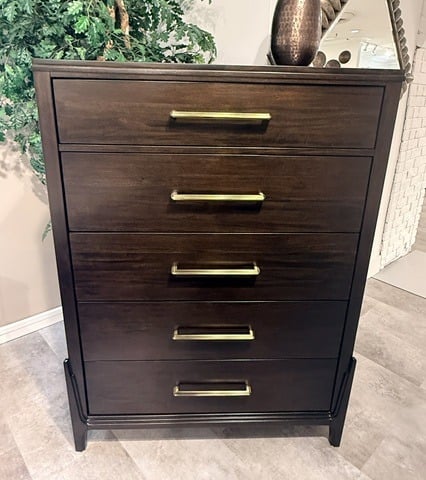
A-America’s planning balances that responsiveness with the time needed to bring an idea to retail.
“We try to be as on trend as possible because realistically, by the time you have an idea and by the time it hits a dealer’s floor, it’s over a year,” said Tyler Rohrbach, director of special projects. “So you’re always planning ahead.”
That process can also mean departing selectively from a core material. President Christian Rohrbach pointed to an expandable dining table made with veneer because solid wood could not provide the required stability.
The choice put the consumer benefit ahead of a uniform construction story, giving retailers a feature to demonstrate while retaining the company’s broader emphasis on functional dining furniture.
“Even though it’s not solid wood, you couldn’t do this in solid,” he said. “But just this design feature, this expandability, we had to jump on it.”