



















discarded synthetic textiles become porous structural material through heat fusion

Heat-Fused Textile Waste Becomes a New Architectural Material
Fast Fashion Architecture is a material research project developed by London-based multidisciplinary designer Taylor Leung of 12103 Design Studio in collaboration with Chung Yin Jeffrey Kwong, Chao-An Chang, Chong Li, and Jiali Yan at The Bartlett School of Architecture in 2022. The project investigates how discarded synthetic textiles can be transformed into a construction material for furniture, structures, and architectural space.
The project examines the relationship between the production methods of fashion and architecture, focusing on shared approaches to textiles, material efficiency, and flexibility. It responds to the disposable nature of fast fashion by exploring how synthetic garments and factory offcuts can be redirected into a new material system with extended applications and lifespans.
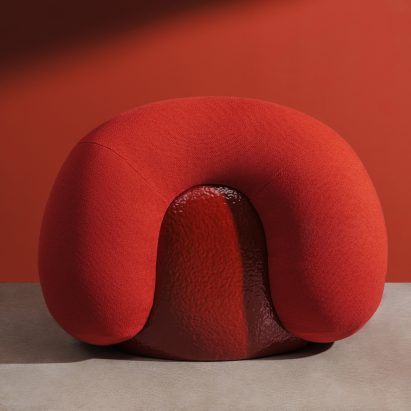
Fast Fashion Architecture works primarily with non-biodegradable synthetic garments and factory waste containing woven polyester fibers. Because these fibers are difficult to separate or reprocess through conventional recycling methods, the project uses heat to fuse the textiles together. Garments are first sorted and cut according to their color and material composition, then packed into mild-steel cages and heated without adhesives, resin, or additional binders. The thermoplastic fibers bond to one another, producing porous units that retain the colors, patterns, textures, and irregularities of the original garments.

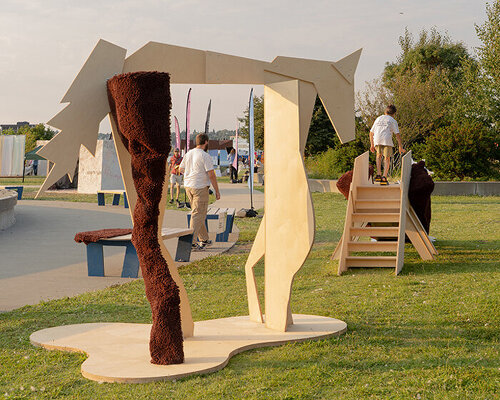
Soft Brutal Chairs Group | image ©Piers Allardyce
A Modified 3D Printer transforms Textile into Heat-Fused Blocks
To control the heat-fusion process, the team adapted a desktop 3D printer into a semi-automated machine described as a form of ‘digital soldering’. Five heated tips move through the compressed textile using customised G-code, allowing the bonding pattern to be adjusted through variations in temperature, density, and spacing.
The process combines the repeatability of digital fabrication with the variable characteristics of discarded textiles. Each material unit retains differences inherited from the garments, while the digital system provides control over how the fibers are bonded and how the resulting material is configured.
The resulting fabric cubes were tested across a series of scales and applications. Initial material samples were followed by an outdoor wall, furniture pieces including chairs, and a structural column. The material was subsequently developed into a prototype shelter at Grymsdyke Farm.

chairs made from heat-bonded discarded polyester garments held within mild-steel cages and textile waste | image ©Piers Allardyce
Discarded Garments Expand into a spatial Construction System
The shelter uses a CNC-cut timber frame and takes the tent as a reference to one of the earliest forms of shelter. Its pyramidal geometry also recalls a mound of discarded textiles, connecting the form to both the accumulation of fashion waste and the possibility of its material reuse.
Further speculative studies extend the system to the scale of a three-story house, examining how the heat-fused textile units could move beyond individual objects and become part of a larger architectural construction system.
Fast Fashion Architecture proposes a model in which material can circulate between industries, transferring waste from garment production into architectural applications. The project shifts synthetic textiles from a short-lived product cycle toward new forms of construction, furniture, and spatial enclosure.

Group Fabrick Multicolor, heat-bonded fabric units retain the colors, textures and irregularities of their garment source | image ©Project Team
Leung’s background in fashion informs the project’s approach to material, body, color, pattern, and assembly. After studying fashion at London College of Fashion, Leung completed an MArch with Distinction at The Bartlett. The interdisciplinary methodology developed through Fast Fashion Architecture continues across his practice in architecture, art, material research, and fabrication. Fast Fashion Architecture received the Bartlett B-Pro Architectural Design Bronze Medal in 2022.

Digital Soldering Rig – 1, the custom digital-soldering rig adapts a desktop 3D printer to apply controlled heat through a packed textile | image ©Project Team

Digital Soldering Rig Close-up, heated tips move through the textile in a programmed grid, testing temperature, density and spacing | image ©Project Team

Soft Brutal Chair Portrait | image ©Project Team

Soft Brutal Chair Column, detail showing the textile fill and mild-steel cage as visible parts of the construction system | image ©Project Team

Fabrick Wall Outdoor, outdoor wall prototype assembled from heat-bonded garment-waste units | image ©Project Team

Soft Brutal Column Installation, the material system scaled into a column prototype, testing vertical assembly and repetition | image ©Project Team

Fabrication Workshop, fabrication process showing the project team developing and assembling material prototypes | image ©Project Team

Prototype Shelter, prototype shelter at Grymsdyke Farm tests the material system at a human and spatial scale | image ©Project Team

Soft Brutal House, speculative architectural application of the material system at building scale | image ©Project Team
project info:
name: Fast Fashion Architecture
designer: 12103 Design Studio | @12103_design_studio
design team: Taylor Leung, Chung Yin Jeffrey Kwong, Chao-An Chang, Chong Li and Jiali Yan
photographers: Piers Allardyce | @piersallardycephotographer, project team
designboom has received this project from our DIY submissions feature, where we welcome our readers to submit their own work for publication. See more project submissions from our readers here.
edited by: Christina Vergopoulou | designboom
The post discarded synthetic textiles become porous structural material through heat fusion appeared first on designboom | architecture & design magazine.