







hoshino hotel opens within the historic, radiating structure of japan’s former nara prison

a former prison becomes a hotel in nara
On a 25-acre site in Nara, Japan, red brick walls and radiating cell blocks now frame HOSHINOYA Nara Prison, a 48-room hotel built inside one of Japan’s most unusual surviving modern landmarks. The initial announcement surfaced in June 2022 and again when more details were unveiled in September 2023.
The former prison, completed in 1908, carries the scale and discipline of a Meiji-era institution, with a central guardhouse and long wings extending outward in a plan designed for surveillance.
Hoshino Resorts has opened the property as a heritage hotel after approximately seven years of restoration and renovation, turning a nationally designated Important Cultural Property into a place for overnight stays.
The project is worth looking at for its design challenge as much as its unusual program. It’s a building designed for confinement has been adapted into suites, lounges, courtyards, and a museum, while retaining the spatial logic that made it so distinct in the first place.

HOSHINOYA Nara Prison opens inside the former Nara Prison, a Meiji-era landmark completed in 1908
radial cell blocks and hand-laid brick
Designed for Hoshino Resorts by Azuma Architect & Associates, the former prison is the last of the Five Great Prisons of Meiji to remain almost fully intact. Its Haviland System layout radiates from a central guard station, giving the complex a strong geometric order that still shapes the guest experience today.
Visitors enter through the original main gate before facing the guardhouse and the cell wings beyond, where the building’s former function remains legible through proportion, repetition, and material.
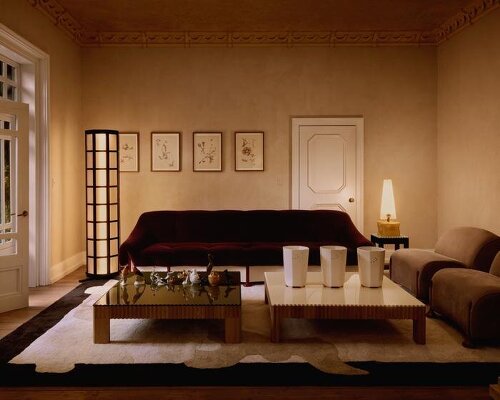
Inside the guest rooms, former cell blocks have been connected to create suites, including the 11-Cell Deluxe, the largest room type at the property. Exposed brick appears beneath areas of original plaster, ceiling mouldings have been retained, and new steel reinforcements sit alongside wood paneling.
The renovation does its strongest work when these layers remain visible, allowing the hand-laid brick, vaulted ceilings, and added structure to read together without smoothing away the building’s past.

the 48-room hotel preserves the radial cell block layout of the original Haviland System plan
new interiors inside old walls
The main lounge occupies an open atrium space where original beams, arched openings, and contemporary lighting set the rhythm of the interior. Rie Azuma of Azuma Environmental Architectural Research Institute led the hotel architectural design, working with a building whose spatial character was already unusually strong.
European furnishings appear throughout the property as a reference to the Western influence that shaped parts of Meiji-era design culture.
The landscape design, led by Hiroki Hasegawa of On-Site Planning and Design Office, treats the areas inside the walls as an “outside within.” Open security zones have been preserved where possible, while planted fragments and geometric white walkways introduce a new reading of the courtyard.
At night, lighting by Masanori Takeishi of ICE Urban Environmental Lighting Institute uses indirect illumination and handcrafted ceramic fixtures, giving depth to corridors and open spaces without turning the prison fabric into a theatrical set.

the main lounge occupies an atrium defined by original beams, arched openings, and new lighting
preservation as a new use
The project also includes the Nara Prison Museum by Hoshino Resorts, connected to the hotel by an exclusive guest pathway. The museum interprets the architectural and social history of the former prison through design and art, extending the adaptive reuse beyond the rooms themselves.
Conservation and renovation were overseen with Yasui Architects & Engineers, with seismic reinforcement and hotel infrastructure integrated into the Important Cultural Property.
Across the project, the most compelling design move is the decision to keep the building’s institutional order visible. HOSHINOYA Nara Prison enters a larger conversation around adaptive reuse in Japan, where preservation more and more depends on programs that can keep large historic structures active.
Here, the hotel format brings visitors into direct contact with a difficult type of building type, allowing the brick walls, radial plan, and restored details to carry the story through space.

hand-laid brick appears beneath original plaster finishes throughout the restored interiors

The project includes the Nara Prison Museum by Hoshino Resorts, connected to the hotel by a guest pathway

former cells have been connected to create suites while keeping brickwork and ceiling details visible

Rie Azuma led the hotel architectural design, with conservation work by Yasui Architects & Engineers

contemporary lighting brings depth to the corridors, lounges, and courtyard spaces

the courtyard introduces geometric white walkways and planted areas within the historic prison walls
project info:
name: HOSHINOYA Nara Prison
location: 18 Hannyaji-cho, Nara, Japan
hotel design: Azuma Architect & Associates
company: Hoshino Resorts | @hoshinoresorts.official
site area: 100,478.80 ㎡ (including the adjoining museum)
The post hoshino hotel opens within the historic, radiating structure of japan’s former nara prison appeared first on designboom | architecture & design magazine.