






















what’s a primate to quantum mechanics? in conversation with daniel birnbaum and jacqui davies
The Quantum Effect at OGR Torino
At OGR Torino, The Quantum Effect, an expansive exhibition on art and quantum theory, illustrates the seemingly unknowable principles of quantum mechanics with mirrors, monkeys, and monoliths. To enter the exhibition, one must pass through a series of mirrors that create a dizzying sense of disorientation. Turn a corner, and there’s a projection of those reflective halls being played back to the viewer. It’s a visual collapsing of perception that speaks to the uncertainty of the universe.
In conversation with designboom, curators Daniel Birnbaum and Jacqui Davies discuss how they connected Mark Leckey, Yayoi Kusama, and Tomás Saraceno with Heisenberg’s Uncertainty Principle and Dirac’s Equation. On the interdisciplinary nature of the show, Davies remarks, ‘By placing artworks, experiments and equations in dialogue, the exhibition affirms the validity of each of these languages while resisting their collapse into a single explanatory framework. The show operates – to quote the title of Ryan Gander’s installation – as a ‘school of languages.’ It unfolds across sign systems.’
In conversation with Birnbaum and Davies
The curators for the show at OGR Torino consulted Professor Ulf Danielsson, professor of theoretical physics at Uppsala University and Secretary of the Nobel Committee for Physics, to highlight equations important to the field. On this collaboration, Birnbaum notes, ‘Our exhibition tries to stage the co-existence of these symbolic systems without privileging one over the other… [Danielsson] selected the equations that best capture the essence of phenomena such as entanglement, superposition, teleportation, parallel universes or the beginning of quantum computing. Most of us of course cannot read them but Ulf likes to emphasize their beauty.’
Quantum Ideas in Television
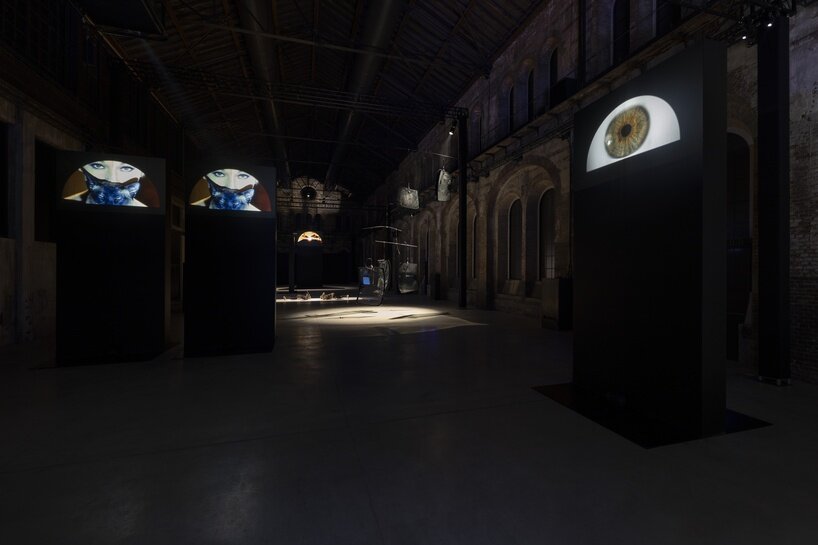
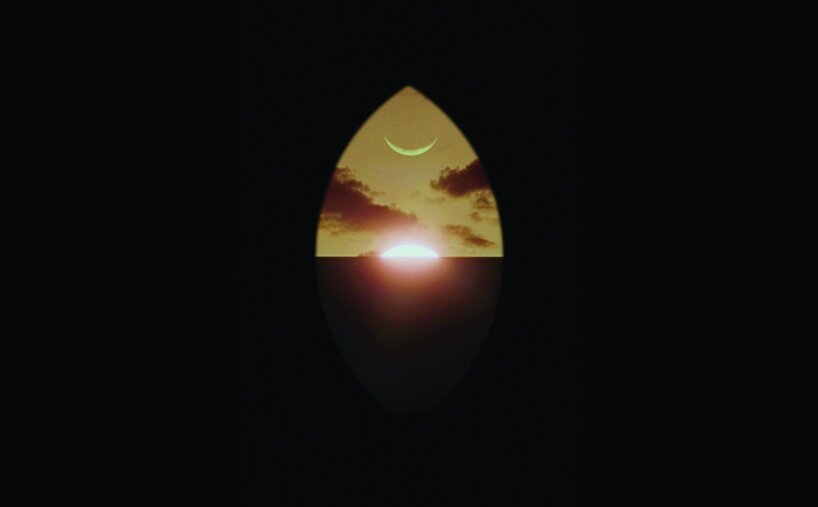
Within the exhibition, when staring up at the black monoliths – a wink to Stanley Kubrick’s 2001: A Space Odyssey – these equations appear on the screen as scenes from The Matrix, Star Trek, and footage of Schrödinger’s cat appear from towering heights. Davies, who created the monoliths in a series called Cinematic Blossomings, notes that she, ‘reassembled fragments [she remembers] from cinema, TV and pop culture to make new film-works which resemble ideas from quantum theory,’ in order to create the work.
Although they are not perfect reflections of these scientific principles, this media begins to hint at a shared understanding of the universe. ‘That is what we mean with the quantum effect,’ Davies emphasizes. ‘Even if they remain incomprehensible on an analytical level we are all familiar with some of these phenomena. In The Terminator, Star Trek, TRON, or Wonder Woman, or David Cronenberg’s The Fly we see bodies shimmer, dematerialize and re-materialize elsewhere. We all grew up with teleportation as something almost normal, happening every day on TV. Other films employ different ideas from quantum physics in imaginative ways.’
On the inclusion of pop culture, Birnbaum acknowledges that, ‘Clearly they have sometimes been simplified or even vulgarized, but we are all familiar with visually extremely powerful imagery,’ citing Kubrick’s film as a prime example. ‘One can find versions of the Many World Interpretation of quantum physics in any number of science fiction movies and speculative works of literary fiction, from Jorge Luis Borges to Philip K Dick or the Matrix. In that way some of the bewildering paradoxes explored by physicists have entered an imaginary that we all share.’
Ripples of Duchamp
‘Although quantum concepts have become trendy in the artworld in recent years their aesthetic reverberations can be traced throughout the twentieth century.’ Birnbaum remarks, emphasizing that not just pop culture, by the fine arts, have been a site for this exploration. ‘Long before ‘quantum’ became a catchphrase, one finds moments in which science seem to converge in surprising ways. We think Marcel Duchamp’s Large Glass, with it’s exploration of many dimensions, is an example of such convergence.’
Within the exhibition is the persistent fanning out of Duchamp’s influence, pointing to his persistent use of repetition, breaking, and glass. There’s an explicit reference with the inclusion of a photo taken by Man Ray in 1923 of Duchamp holding his work Glissière Contenant un Moulin à Eau (en métaux voisins) (Glider Containing a Water Mill [in Neighbouring Metals], 1913–15). There’s also Sturtevant’s Duchamp descendant l’escalier (1992), a black-and-white photographic interpretation of Duchamp’s painting Nude Descending a Staircase, both of which depict the repetition of a body as it, frame by frame, moves across the canvas.
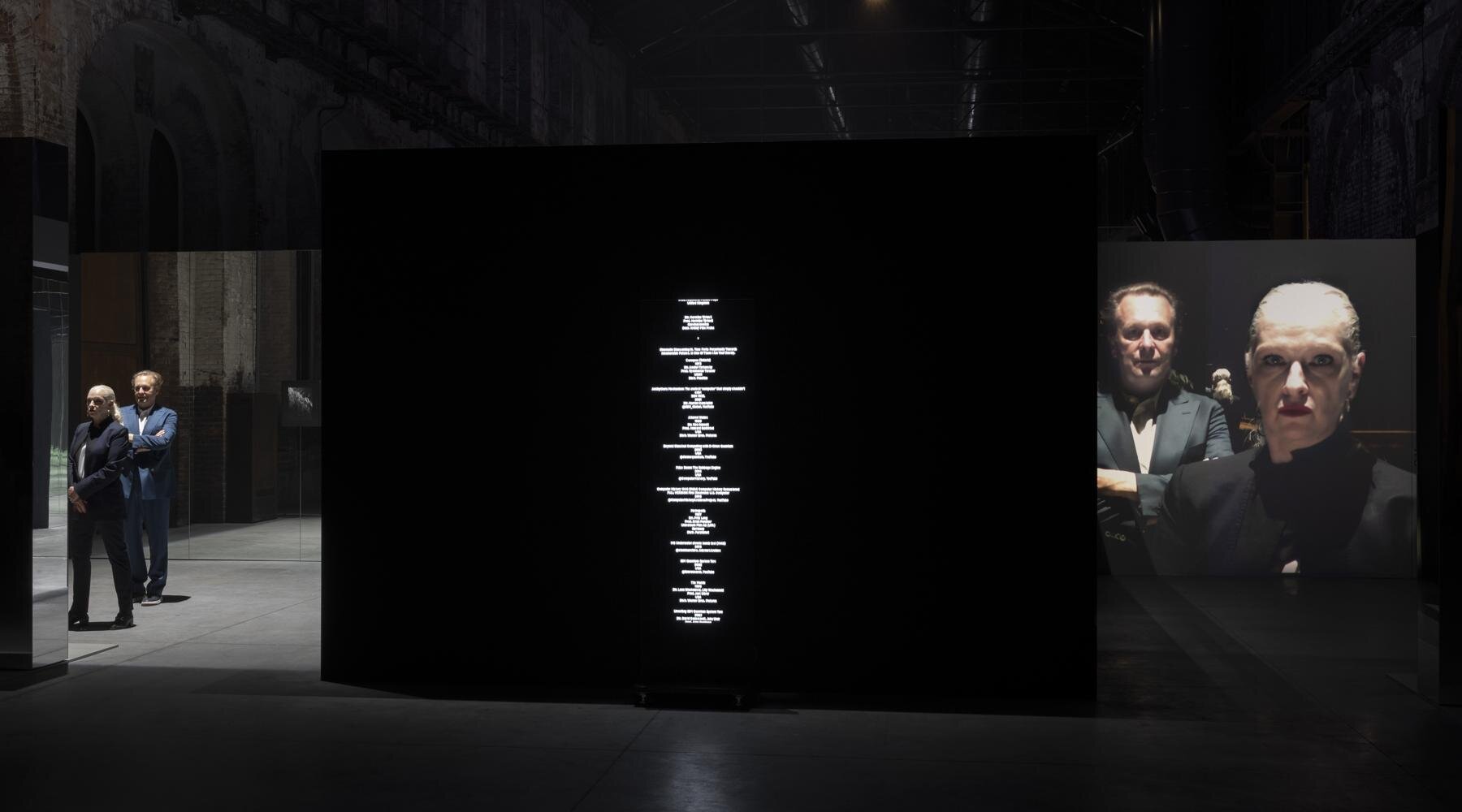
even with the most advanced mathematics and scientific theories, the universe remains fundamentally elusive
Looking through the broken glass
More subtly, there’s Cerith Wyn Evans’s Phase-shifts )( manifest [after D.T.] (2026), a mobile of cracked windshields, with D.T. in the title standing for ‘delay in time.’ The breaking of glass continues in Mark Leckey’s 2021–22 film, To the Old World (Thank You for the Use of Your Body), in which a man launches his body through a bus stop glass wall, the shards and fragments of which splay into a dark void upon impact. ‘Many of the works explore the possibility of breaking through the glass that separate us from another reality,’ says Davies on the recurrence of the material, ‘One of our curatorial starting points was the novel Locus Solus by Raymond Roussel, an early example of what today is called quantum fiction. In that novel a scientist guides a party through extraordinary, unbelievable things are presented, always behind glass.’
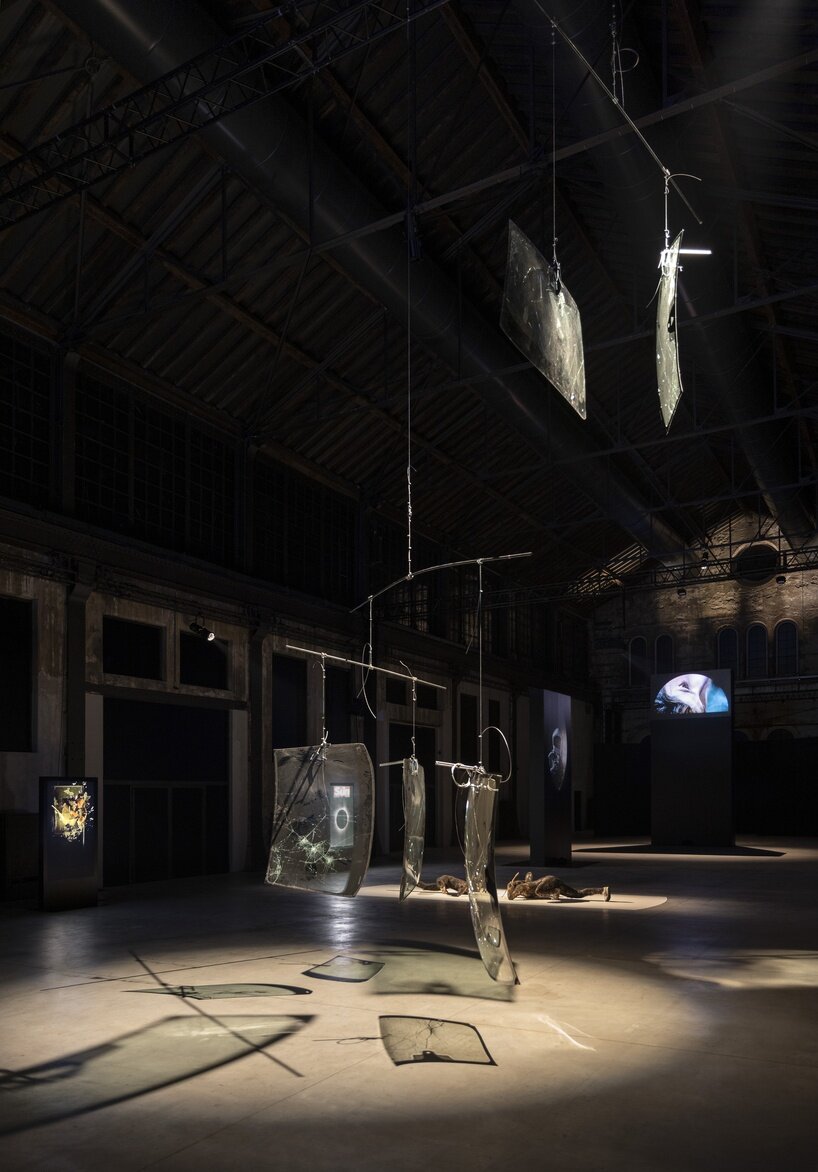
Primates and the beginning of humanity
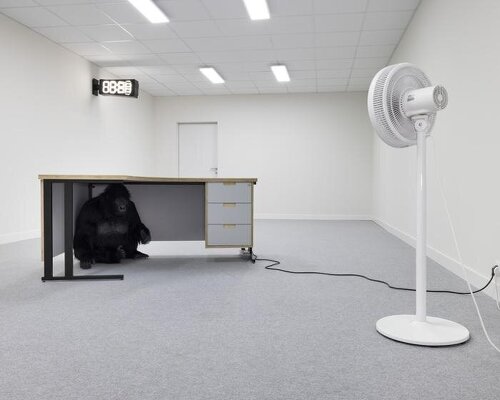
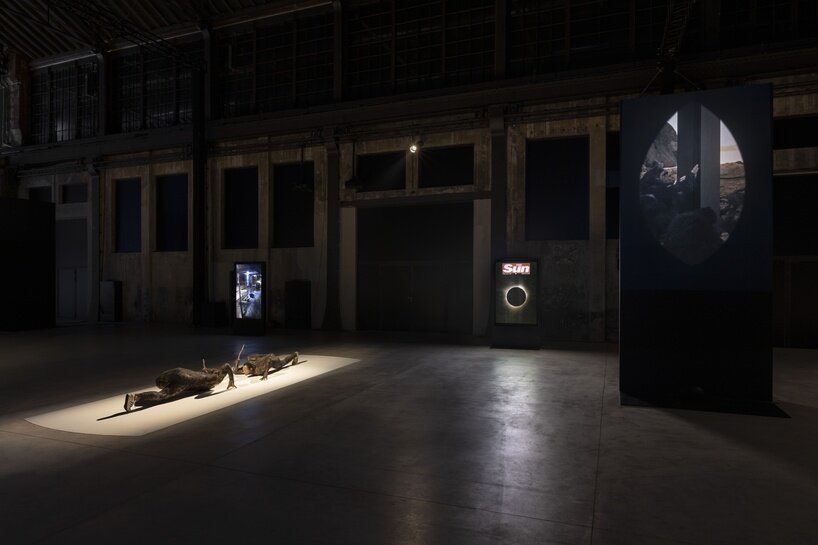
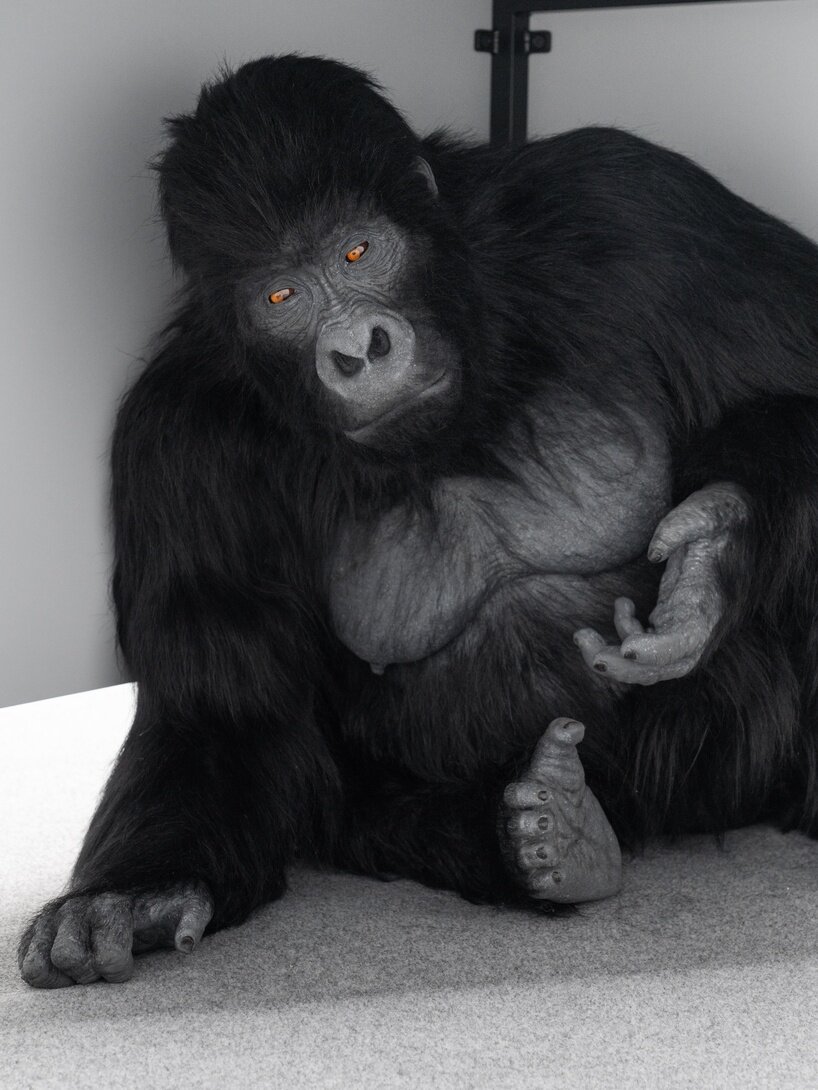
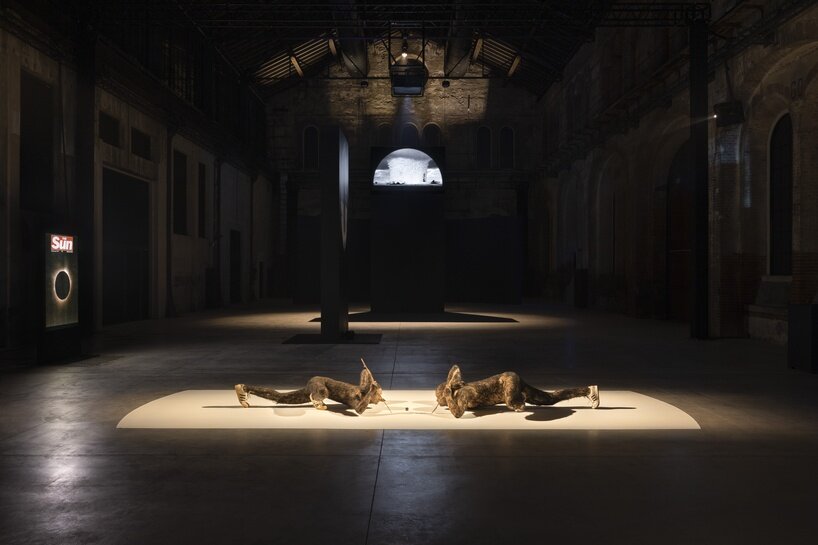
Duchamp’s influence carries on into the primate-heavy works in the exhibition. There’s Rirkrit Tiravanija’s untitled or (the savage detectives) (2025), in which two man-ape figures are crouched on the ground, bearing sticks and staring at a replica of Duchamp’s Peigne, a comb with the inscription, ‘3 or 4 drops from a height have nothing to do with savagery.’ This continues into the liminal space of Ryan Gander’s office space, where School of Languages (2023) and Chronos Kairos 01.01 (2025) are being shown. In a white-walled room, an ape named Brenda cowers underneath a corner desk, only visible when you traverse to the other side of the room and peer underneath. Hanging is a digital clock with the time 88:88, which doesn’t exist on our traditional 24-hour clock.
Once again, there’s a heavy reference to perhaps what can be considered a time before man, the primates that preceded us. With the heavy referencing to Kubrick’s film, one can’t help but think again of that moment where the monolith appears, interrupting linear time with its presence. Here, the curators are calling back to the idea that maybe this straight progression of time, one where we can easily track fish to ape to man, is perhaps more complicated than we may believe.
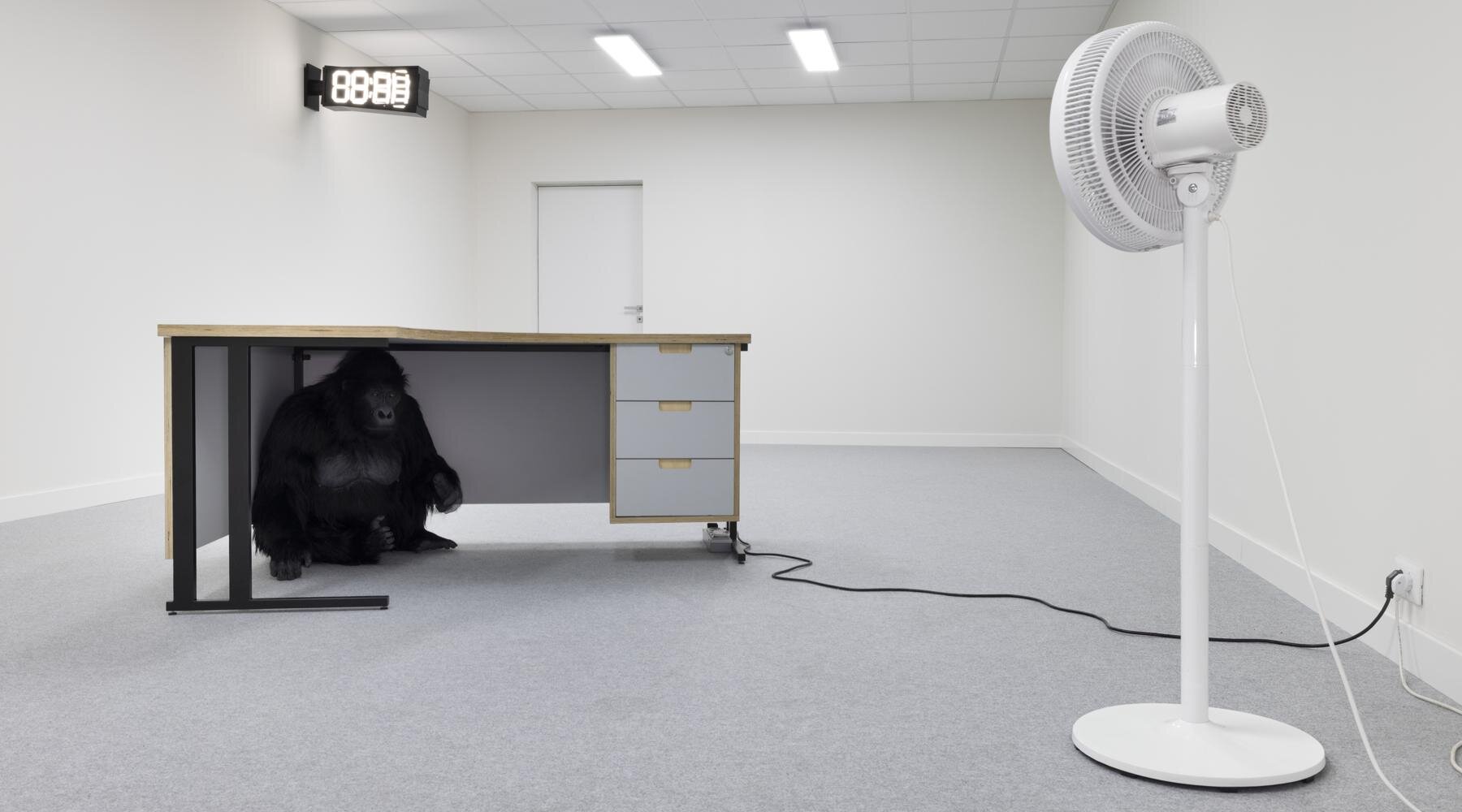
the liminal space of Ryan Gander’s office space, where School of Languages (2023) and Chronos Kairos 01.01 (2025) are being shown
The Quantum Effect on mankind
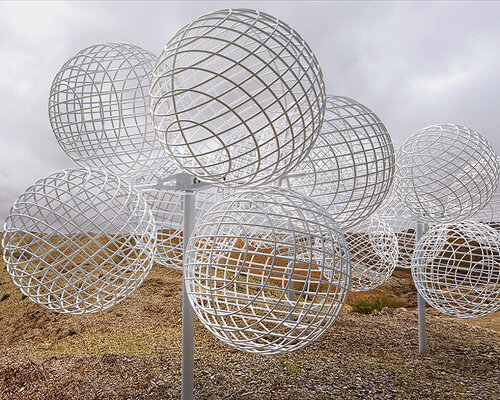
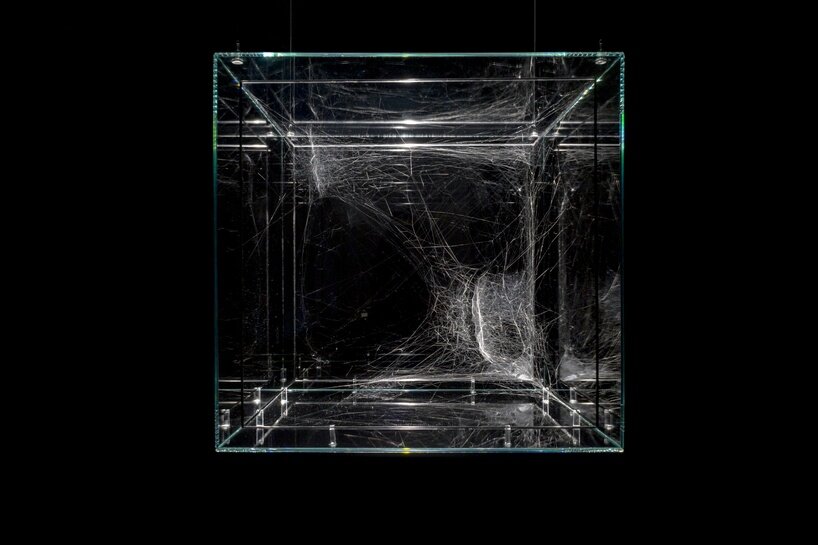
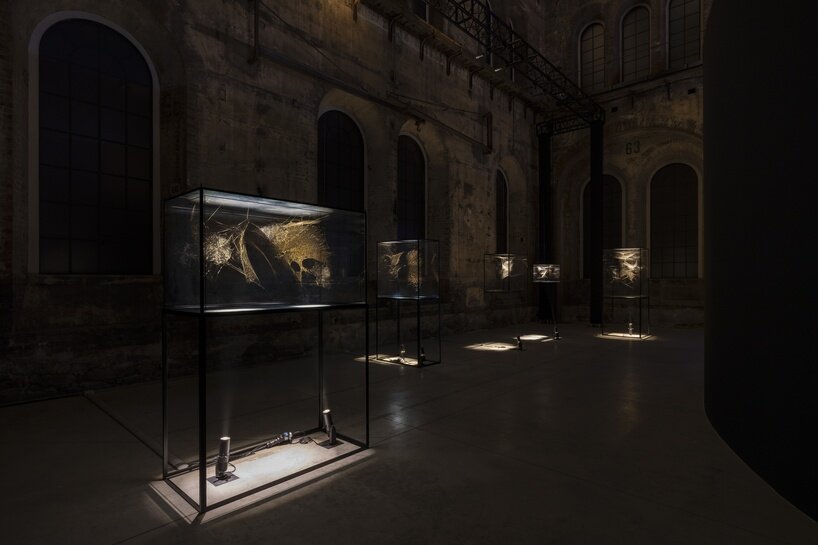
What emerges in The Quantum Effect is less a definitive explanation of the universe than an invitation to reconsider how we understand it. Like the intricate webs of Tomás Saraceno, whose glowing structures trace paths of seemingly incomprehensible complexity, the exhibition brings together a constellation of references, ideas, and artistic gestures that resist a single point of interpretation. ‘For Tomás they are ciphers of the universe itself. He can talk for ever about string theory in front of these complex creations by spiders,’ says Brinbaum. ‘Good art is never just an illustration of theories. But sometimes one detects this strange convergence between languages.’ From quantum equations and fractured reflections to primates, monoliths, and Duchampian repetitions, the works unsettle familiar understandings of time, perception, and human progress.
Even with the most advanced mathematics and scientific theories, the universe remains fundamentally elusive. Rather than attempting to resolve these uncertainties, the exhibition embraces them, finding in the unknown a space for speculation, connection, and wonder. Ultimately, The Quantum Effect suggests that understanding the world may not be a matter of finding definitive answers, but of remaining open to the possibilities that emerge when art and science meet.
project info:
name: The Quantum Effect
location: OGR Torino, Italy | @ogr_torino
dates: October 31, 2026- February 25, 2027
curators: Daniel Birnbaum and Jacqui Davies
artists: Cerith Wyn Evans, Isa Genzken, Tomás Saraceno, Mark Leckey, Rirkrit Tiravanija, Sturtevant, Emilija Škarnulytė, Ryan Gander, Faustine Studio, and Man Ray
This article is part of designboom’s POSTHUMAN UTOPIAS chapter, exploring what happens when humans are no longer the measure of all things. These stories rethink our relationship with the planet through interspecies architecture, living materials, regenerative landscapes and emerging technologies – learn more here! The chapter is presented in partnership with INDX|GLOBAL – a global cultural platform placing Indian architecture, design, and creative intelligence in conversation with the world.
Each designboom editorial series explores one theme in depth through projects, interviews, features and news across architecture, design, art and technology. Discover more chapters here, and get in touch if you’d like to submit a story through our submissions portal or contact form.
The post what’s a primate to quantum mechanics? in conversation with daniel birnbaum and jacqui davies appeared first on designboom | architecture & design magazine.