











how jerzy became jorge: the polish-born architect who became a brazilian icon

Jorge Zalszupin from Warsaw to São Paulo
Typically, when speaking about a creative, their place of origin will accompany their title: French for Le Corbusier, Brazilian for Oscar Niemeyer. For architect Jorge Zalszupin (or Jerzy Zalszupin, depending on the time of life you met him), this regional hyphenate is one that eludes him. Born in Warsaw in 1922, he witnessed the Second World War in Europe, practiced in the content, and eventually emigrated to Brazil. Calling these two countries home, his approach to architecture and furniture design was a meld of their sensibilities, making for a 20th-century designer who captured the expanding worldview of the period.

architect Jorge Zalszupin, known for his role in Brazilian Modernism, was born in Warsaw in 1922 and later established his practice in São Paulo | all images courtesy of Casa Zalszupin unless stated otherwise
founder of Casa Museu Zalszupin Lissa Carmona
In the last two decades of his life, Lissa Carmona – CEO and curator of ETEL – worked with the late designer. ‘one day he schedule an appointment with me here,’ Carmona tells designboom of one of their meetings in ETEL’s gallery space, ‘and brought a bunch of type-written papers and gave it to me saying something like “you are so fond of my stories I believe you will like this.”And it was his autobiography.’ The two met in the mid-1990s and continued to collaborate through this period. Carmona would go on to curate the show Warsaw – São Paulo – Milan. Jorge Zalszupin’s Brazilian Modernism and found and directed Casa Museu Zalszupin, a site for preserving his legacy, housed in his former personal residence in São Paulo.

in the last two decades of his life, Lissa Carmona – CEO and curator of ETEL – worked with the late designer and went on to found and direct Casa Museu Zalszupin | image © Ruy Teixeira, courtesy of ETEL
Creating between Warsaw and São Paulo
When curating the retrospective of his career, Carmona was witness to the physical documents, drawings, and ephemera that documented his life. ‘During this process some beautiful bridges were built as the correspondence with the Romanian university where he studied and also some Polish universities started researching more about him and are coming to Brazil.’ It is said that witnessing the drawings by Le Corbusier in a book is what incited his interest in architecture. His life was shaped by the war that took over Europe in the early half of his life: his family escaped Poland to Romania to flee the Holocaust. After finishing his studies in architecture, he relocated to France and was involved in the reconstruction of Dunkirk.
In 1949, looking for a fresh start away from postwar Europe, Zalszupin found his second home in Brazil. Upon receiving his Brazilian citizenship a few years later, he changed his name to ‘Jorge.’ On the influence these two places had on him, Carmona remarks, ‘we can sense the Europeans roots in his design legacy, the rational usage of wood, the quiet elegance of the lines, but at the same time he was passionate by the exuberance of Brazilian tropical woods, the modern architecture of Niemeyer, and the strength of the nature and he incorporated that in his aesthetics.’

In 1949, Zalszupin found his second home in Brazil and upon receiving citizenship a few years later, he changed his name to ‘Jorge’
Designing chairs and trollies for the home
In Brazil, Zalszupin founded his furniture studio L’Atelier. He would expand the studio to employ over 200 people, becoming known for futuristic-looking pieces created with curved laminates and plastic. ‘I could say that the most sophisticated, elaborated design pieces were the wooden ones from 1949-1959 most of them for residences, and his philosophy or approach for the domestic spaces were very clever and rational with exquisite composable bookshelves (as the Kovacs for instance) or set of sofas and armchairs as the Cubo collection, but at the same time very elegant and sophisticated crafted. His pieces were masterpieces in terms of craftmanship and also very timeless.’
Carmona cites the Dinamarquesa armchair and the Tea Trolley as stylistic exemplars from the designer’s practice. The former sports upholstered seating on a silky wooden frame with tapering profiles that became a hallmark of midcentury design. Though here, when the seat and armchairs meet at a near 90-degree angle on the armrests, the corner juts out ever so slightly. His Tea Trolley is equally dynamic, sporting geometric wooden shapes and playfully exaggerated brass wheels.

Casa Museu Zalszupin has gone on to host exhibitions on Zalszupin, Oscar Niemeyer, artist Felipe Cohen and designer Percival Lafer
Preserving Casa Zalszupin in São Paulo
The legacy of Zalszupin is found not just in his furnishings, but in grand architectural projects in the country. In 1962, Oscar Niemeyer invited him to furnish Brasília, which had become the country’s new capital just two years prior. Given Carmona’s relationship with the designer and seeing the mark he left on the South American country, she took the reins on preserving his home as a site of preservation and study. Stylistically, she notes how it encapsulates his journey, ‘His house is the best example of these two “homes” the ceiling being in Riga pine a typical wood from eastern Europe in perfect dialogue with the floor in the typical and famous Brazilian Rosewood, the influence of Scandinavian architecture with the ceramic colored tiles similar to Lina Bo Bardi’s glass house.’
‘I needed to do something to not only preserve his story but very much promote it. And the house is an architectonic gem, is a laboratory of his ideas, references and experiments, it’s a testimony of his geniality and how was the modernist architecture and also the life in the 60’s in Sao Paulo Brazil, and that is crucial to be understood to be preserved, it’s our history.’

Zalszupin founded his furniture studio L’Atelier, becoming known for futuristic-looking pieces created with curved laminates and plastic

his former home has become a site for documenting, preserving, and maintaining his legacy | image © Ruy Teixeira, courtesy of ETEL

an image of a geometric facade at the Casa Zalszupin house-museum in São Paulo

it is said that witnessing the drawings by French architect Le Corbusier in a book is what incited his interest in architecture.

after finishing his studies in architecture in Budapest, he relocated to France and was involved in the reconstruction of Dunkirk

an archival image of Zalzsupin’s residence in São Paulo, which would go on to house Casa Museu Zalszupin

Carmona cites the Dinamarquesa armchair and the Tea Trolley (above) as stylistic exemplars from the designer’s practice | image © Ruy Teixeira, courtesy of ETEL

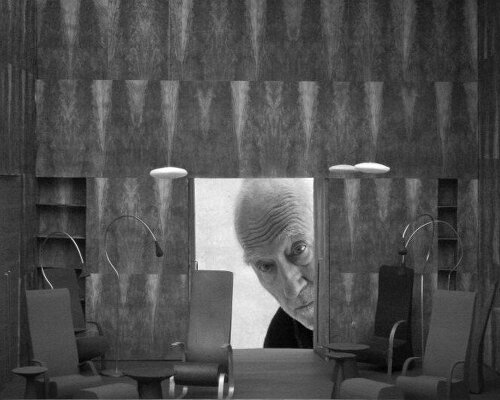
Carmona would go on to curate the show Warsaw – São Paulo – Milan. Jorge Zalszupin’s Brazilian Modernism, pictured above, during Milan Design Week 2026

in 1962, Oscar Niemeyer invited Zalszupin to furnish Brasília, which had become the country’s new capital just two years prior
project info:
designer: Jorge Zalszupin
born: 1922, Warsaw, Poland
died: 2020, São Paulo, Brazil
exhibition: Warsaw – São Paulo – Milan. Jorge Zalszupin’s Brazilian Modernism
location: Torre Velasca, Milan
ceo and curator of ETEL: Lissa Carmona
curator and exhibition designer: Maria Murawsky
dates: April 20 – April 24, 2026
The post how jerzy became jorge: the polish-born architect who became a brazilian icon appeared first on designboom | architecture & design magazine.