







tom sachs turns ceramic failures into a language of craft throughout salon 94

salon 94 displays ceramics inside its NYC townhouse
Within an upper-level gallery space of Salon 94’s Upper East Side townhouse, ceramic works by Tom Sachs appear behind glass, arranged in a white cabinet with red tape along its edges and a familiar NASA mark repeated across their imperfect surfaces.
Some look like bowls, some look like fragments rescued from a kiln disaster, and others seem to have been rebuilt just enough to suggest the shape they once wanted to hold. The patched surfaces, taped seams, and lumpy edges make the case feel like a workshop archive over a display of precious objects.
The setting is Tom Sachs’ Furniture, a full-building exhibition that brings together new and earlier works across furniture, ceramics, lighting, sculpture, and painting.
On May 20th, the gallery opened Satan Ceramics, a group show which included works by Mary Frey, JJ Peet, Pat McCarthy, Luc Hammond-Thomas, and Sachs. As it ran alongside Furniture which opened on April 24th, 2026, the overlap gives the overall display its tension. Sachs’ furniture creates the structure, while the ceramics bring in the messier language of touch, use, damage, and repair.

Tom Sachs, Furniture, Salon 94 Design | image © designboom
tom sachs treats clay as evidence
Across Tom Sachs’ ceramic bowls and cups, failure feels built into the process. A bowl with a blackened rim stands on small metal legs like a piece of space equipment made by hand while, nearby, cracked white forms are stitched back together with gauze, tape, and visible mends.
The NASA logo gives the works a strange institutional confidence, even when the clay itself appears soft, bruised, or barely held in place.
This is where the artist‘s larger practice enters the ceramic work, on view within Salon 94‘s Upper East Side townhouse. His objects often leave screws, joints, seams, and studio decisions exposed, and the bowls follow that same logic at a smaller scale. They hold onto the labor that made them.
The repaired pieces feel especially strong because they resist the clean finish expected from functional ceramics. They point to an intended shape, then let the viewer stay with everything that interrupted it.

Tom Sachs, Furniture, Salon 94 Design | image © designboom
JJ Peet brings contrast to the ceramic story
Among the Satan Ceramics works, pieces by artist JJ Peet give the exhibition its strongest counterpoint. His vessels sit atop Tom Sachs’ new Walnut Jeanneret Tables with a different kind of physical charge, their surfaces built up through vibrant color and blocky, chopped-up textures.
Some hold flowers, turning the ceramic body into a functional container. The forms can look like small ruins, tools, props, or parts of a model city that have taken on another use.
Peet’s work helps keep the group presentation from becoming only an extension of Sachs’ world. His ceramics bring their own rhythm to the room, with small painted cavities, rough skins, and openings that make each vessel feel handled over time.
They are set against the gallery’s polished interiors and the clean geometry of the table in a way that pulls attention back to clay as a material that records pressure. Their strength comes from how directly they hold the hand.

JJ Peet, Satan Ceramics, Salon 94 Design | image © designboom
furniture becomes a support system
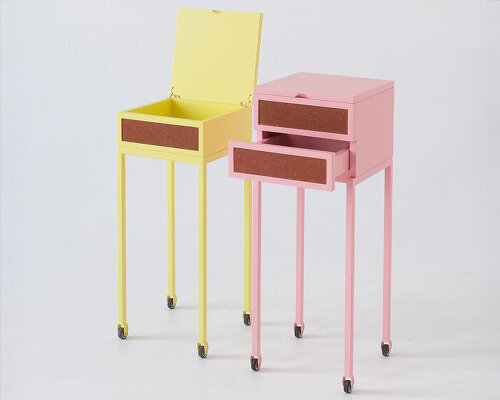
Tom Sachs’ new Walnut Jeanneret Tables play a central role in this reading. They are furniture, but here they also act as a staging system for ceramic collections, giving the smaller works a shared ground without smoothing out their differences. Their broad surfaces allow the objects of the Satan Ceramics group show to gather in clusters, thus turning bowls, cups, flowers, and patched vessels into a loose field of experiments.
Elsewhere in the townhouse, Sachs’ plywood chairs with its circular cutouts extend the same material attitude at the scale of the body. These Shop Chairs use visible fasteners and exposed construction as part of their character, with plywood surfaces shaped through a language that feels open and direct. They sit near larger furniture pieces, lamps, and salvaged forms to connect the ceramic works to Sachs’ long-standing interest in making objects that keep their assembly in view.
The diverse works on view are united by their refusal to treat craft as a polished endpoint. Sachs and Peet both approach clay as a material that can carry error openly. The repaired bowls, the flower vessels, the rough cups, and the tables that hold them all become part of a shared system of making, where process stays visible and damage remains active.

Tom Sachs, Furniture, Salon 94 Design | image © designboom

Tom Sachs, Furniture, Salon 94 Design | image © designboom

JJ Peet, Satan Ceramics, Salon 94 Design | image © designboom

JJ Peet, Satan Ceramics, Salon 94 Design | image © designboom

Tom Sachs, Furniture, Salon 94 Design | image © designboom

Tom Sachs, Furniture, Salon 94 Design | image © designboom

Tom Sachs, Furniture, Salon 94 Design | image © designboom

Tom Sachs, Furniture, Salon 94 Design | image © designboom
project info:
exhibitions: Furniture, Satan Ceramics
artists: Tom Sachs | @tomsachs, JJ Peet | @jj_peet
gallery: Salon 94 Design | @salon94design
dates (Furniture): April 24th — June 20th, 2026
dates (Satan Ceramics): May 20th — June 20th, 2026
location: 3 E 89th Street, New York, NY
photography: © designboom
The post tom sachs turns ceramic failures into a language of craft throughout salon 94 appeared first on designboom | architecture & design magazine.