








david altrath documents the jungle suspended inside london’s barbican conservatory

David Altrath frames a suspended jungle inside a brutalist icon
David Altrath’s photographic series captures the Barbican Conservatory not simply as a greenhouse, but as a spatial paradox embedded within one of London’s most uncompromising architectural ensembles. Conceived in 1982 as part of the Barbican Centre, the conservatory unfolds as a suspended ecosystem where over 1,500 plant species occupy a rigid Brutalist framework of exposed concrete, steel, and glass.
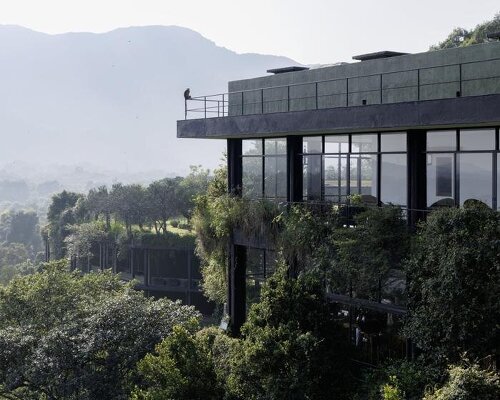
What emerges through Altrath’s lens is not contrast in the obvious sense, but a gradual negotiation. The heavy geometry of the Barbican’s stepped terraces becomes a scaffold for growth, with vines, shrubs, and trees occupying ledges and voids as if they were always intended to be there. The rough concrete surfaces act as a substrate for life rather than a boundary against it. Plants cascade over balustrades, roots anchor into shallow beds, and foliage thickens at corners where light and humidity accumulate.

all images by David Altrath
inside the barbican conservatory, light and growth shape space
Daylight enters diffused and uneven through the glazed roof above, flattening the severity of the structural grid while producing pockets of shadow and brightness that shift throughout the day. Hamburg-based photographer Altrath’s photographs lean into this ambiguity, where visibility is partial and depth is layered.
Corridors narrow into shaded passages before opening into brighter clearings. Reflections on glass merge with foliage, while the city beyond becomes faint. The conservatory behaves like a suspended microclimate, detached from the urban tempo outside. Movement within the conservatory is not linear or monumental. Instead, it is intimate and immersive. Narrow walkways weave through dense planting, occasionally rising to overlook lower terraces before folding back into the vegetation. There is no single vantage point, only a sequence of partial views. Altrath frames these routes as spatial experiences rather than documentation. The camera lingers at thresholds, corners, and moments of compression, emphasizing how the body navigates between architecture and growth.
The Barbican is often framed through its scale, its density, and its unapologetic materiality. Within the same system, a different rhythm emerges, one defined by growth, maintenance, and seasonal change. The conservatory reveals the capacity of brutalist architecture to host life, to absorb time, and to evolve beyond its original intent.

dense planting wraps the conservatory’s concrete terraces, turning structure into habitat

layered balconies dissolve into foliage as vegetation overtakes the architectural grid

diffused daylight filters through the glazed roof, softening the mass of the structure

walkways weave through dense greenery

the conservatory opens into a vast interior canopy

planting beds and brick plinths anchor the landscape

suspended planting blurs boundaries between levels and spatial hierarchies

guiding movement across multiple levels

water, vegetation, and structure converge to form a layered interior ecosystem

rows of potted plants line the perimeter, framing views toward the city beyond

narrow corridors compress movement, guiding visitors through shaded interior paths

vines and trees climb along edges and voids

an indoor pond introduces water as a spatial and atmospheric element within the garden

a narrow walkway runs alongside raw concrete, compressing space between structure and foliage

a constructed microclimate unfolds beneath the glass canopy
project info:
name: Barbican Conservatory | @barbicancentre
photographer: David Altrath | @davidaltrath
architects: Chamberlin, Powell and Bon
location: London, Great Britain
The post david altrath documents the jungle suspended inside london’s barbican conservatory appeared first on designboom | architecture & design magazine.