








from beads and clay to paper and wood, makers keep finding ways to make flowers bloom

flowers as craft’s enduring challenge
Spend enough time looking at contemporary craft and a pattern begins to appear. Glassmakers, ceramicists, textile artists, paper sculptors, beadworkers, and woodcarvers often arrive at the same subject: flowers. Henri Purnell builds delicate blossoms from thousands of glass beads. Julia Oleynik shapes flowers petal by petal in clay. Lilla Tabasso recreates blooms in glass, while Ann Wood, Judith Rolfe, and Sourabh Gupta turn sheets of paper into stems, leaves, and petals. In Japan, Yoshihiro Suda carves flowers and weeds from wood with remarkable precision.
Contemporary craft is constantly evolving, embracing new technologies, materials, and processes. Yet one of its most persistent subjects remains a familiar one. Flowers continue to offer makers a problem worth solving. Unlike geometric forms, flowers rarely follow predictable rules. Petals fold, curl, overlap, and wrinkle, colors shift across a single bloom, and no two specimens are entirely alike. For makers working with rigid, manufactured materials, recreating that complexity requires a series of translations.
Whether assembled bead by bead, stitched thread by thread, or carved from a single block of wood, flowers provide a common point of departure for makers interested in exploring what their materials can do.

PRIMAVERA detail | image by Roberto Marossi via @lilla.tabasso
translating the bloom
Flowers are deceptively difficult objects to recreate. Their forms are perplex and nothing but standard. Their petals curl unpredictably, and their stems bend in different curves. Colors shift subtly from edge to center. No two blooms are ever entirely identical. For makers working by hand, this complexity presents an irresistible challenge.
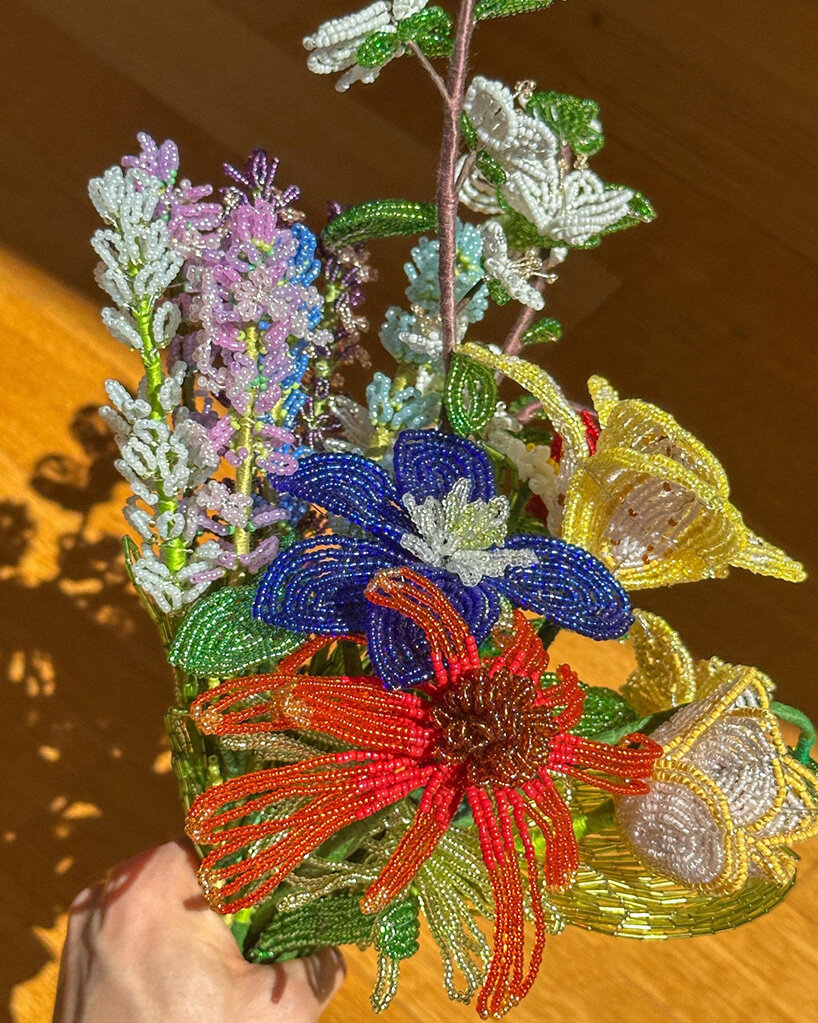
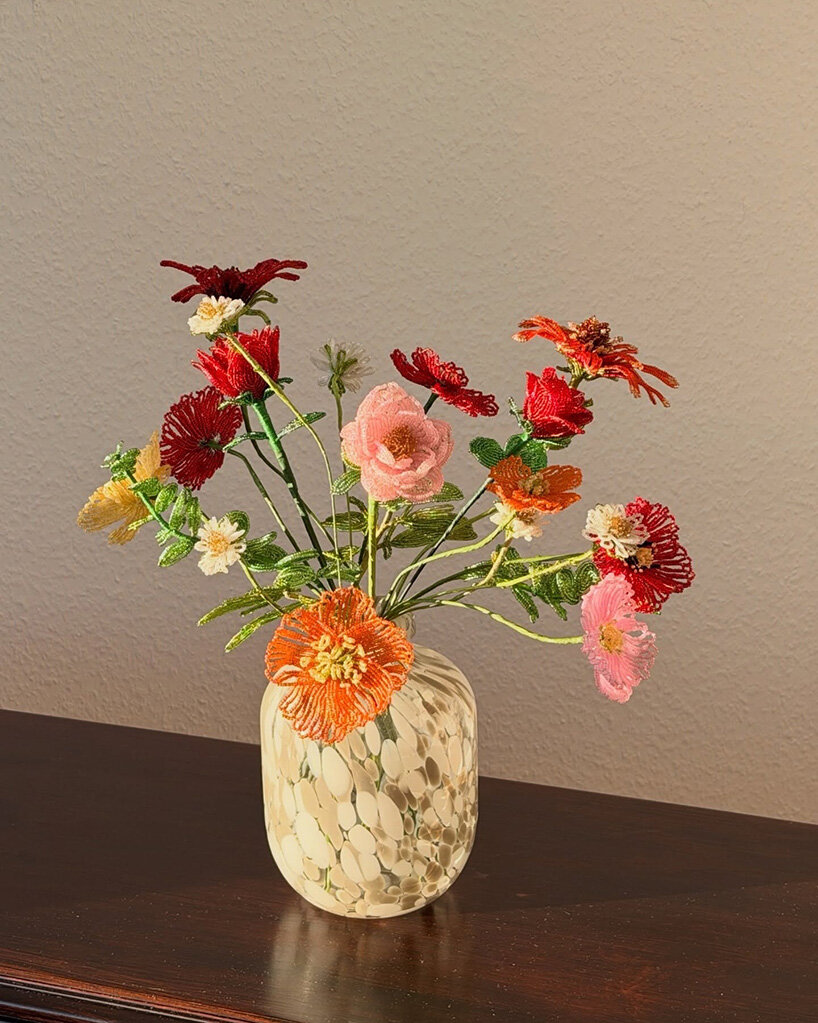
In the work of Henri Purnell, flowers emerge through dense accumulations of glass beads. Thousands of individual components come together to form blossoms that appear fragile. Seen from afar, the sculptures resemble botanical specimens. Up close, they reveal themselves as elaborate systems of repetition, each bead recording a single gesture within a much larger process.
The transformation is striking. A living flower grows through biological processes. Purnell’s flowers grow through labor. The resulting works preserve the time required to construct the complexity of the bloom.
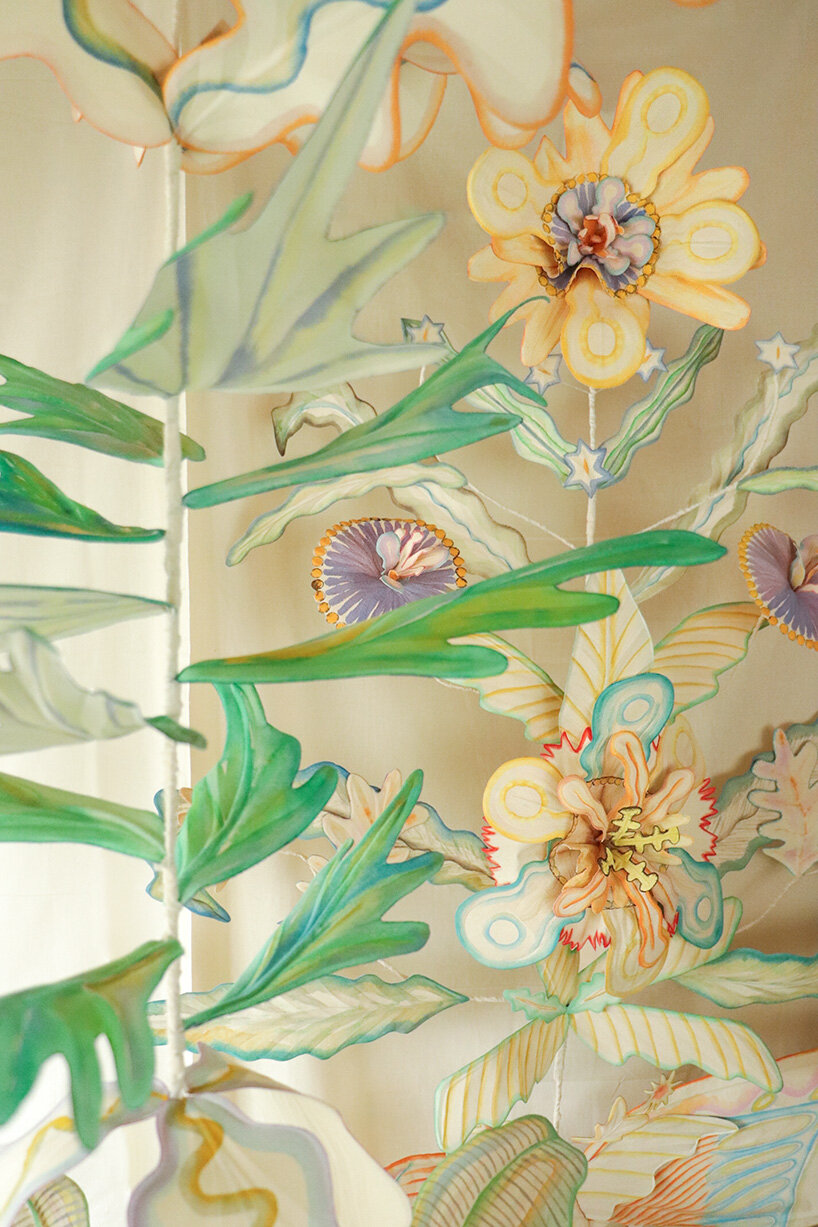
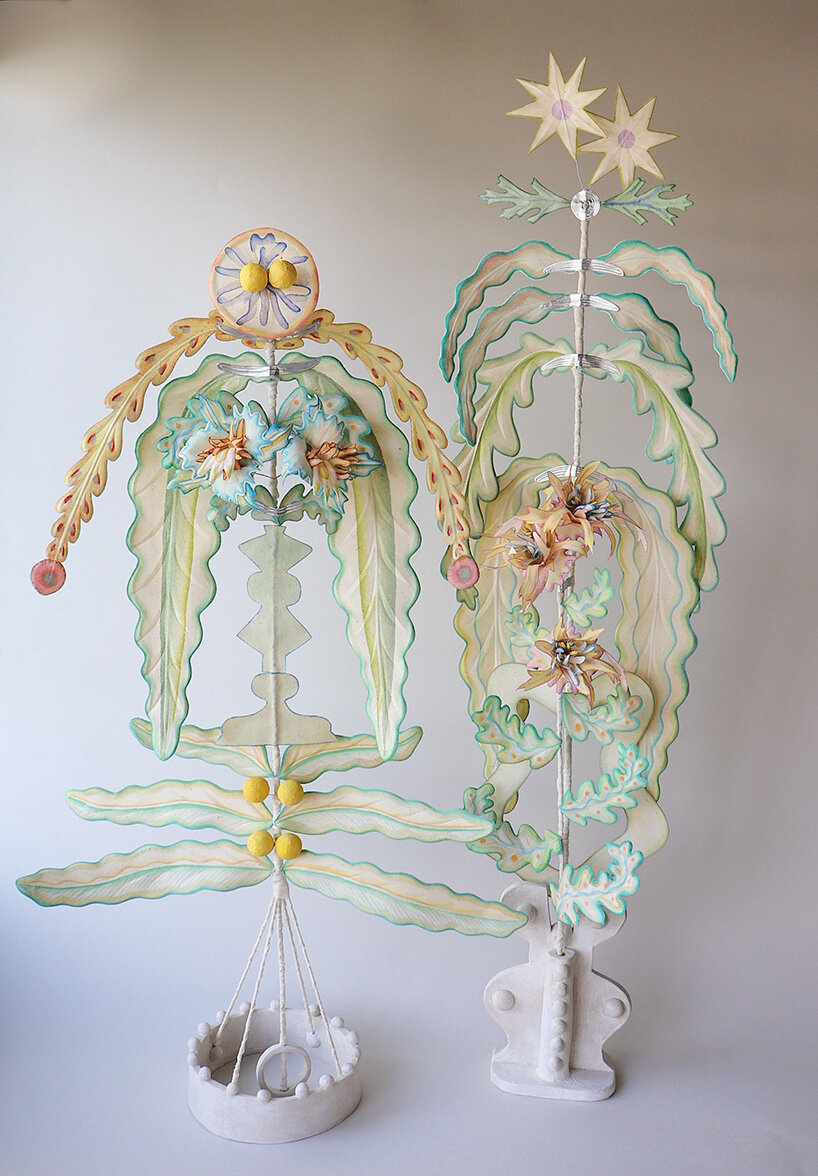
A similar act of translation unfolds through paper. Artists such as Ann Wood, Judith Rolfe, Signe Elisabeth Scharling, and Sourabh Gupta approach botanical forms through cutting, folding, layering, and shaping. Their flowers are not imitations so much as conversations between material and subject. The stiffness of paper is pushed toward softness. Flat surfaces acquire volume. What begins as a sheet gradually becomes a stem, a leaf, or a blossom.
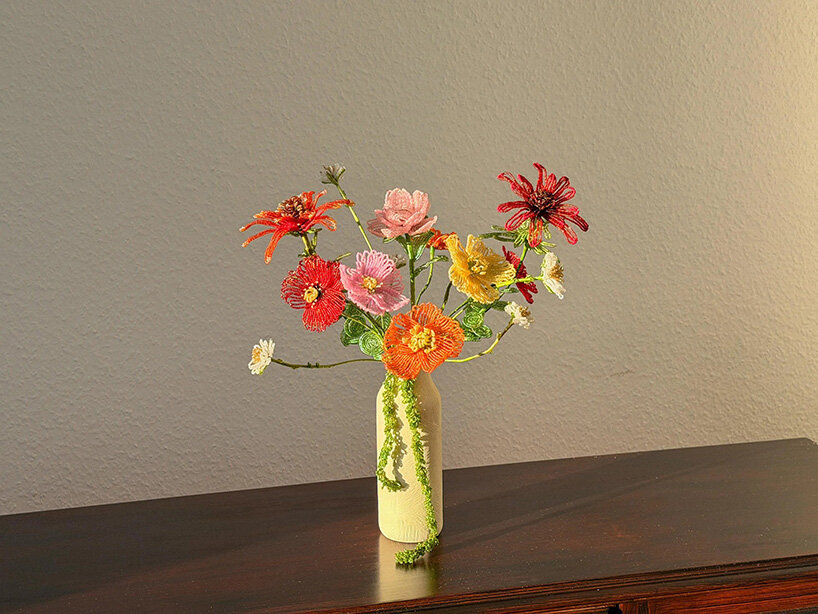
flowers emerge through dense accumulations of glass beads | image courtesy of Henri Purnell
preserving what was never meant to last
The relationship between flowers and craft is also tied to time. A flower is, by definition, temporary. Many makers appear drawn to this paradox, reconstructing fleeting forms through materials capable of lasting decades or even centuries.
Ceramic artist Julia Oleynik creates hyperreal flowers whose delicate petals appear almost impossibly lifelike. Yet unlike their living counterparts, these blooms remain suspended in a permanent state of flowering. Clay becomes a vehicle for preserving a moment that nature cannot hold.
The same tension appears in the work of glass artist Lilla Tabasso. Her intricate floral compositions transform one fragile material into another. Glass shares the delicacy of a flower yet possesses a vastly different relationship to time. What would ordinarily wilt within days can survive indefinitely once translated into molten silica and fire.
Makers hold onto forms that are otherwise destined to disappear by recreating flowers, a way of negotiating permanence and change.

thinly rolling out the clay enables the artist to replicate each flower | image courtesy of Julia Oleynik
the botanical archive
Not every contemporary floral work aims for realism. For some artisans, botanical forms become a means of observation. Using untreated cotton fabric, Mona Sugata builds sculptural works inspired by flowers and plants, capturing their fragility through slow, repetitive handwork. Her textile works appear to grow through repeated actions that mirror organic development. Similarly, the embroidered arrangements of Olga Prinku and the delicate botanical interventions of Hillary Waters Fayle reveal an attentiveness to natural structures that borders on archival.
These artists operate more like collectors, as their works resemble records of sustained looking. Leaves, stems, seed heads, and blossoms are isolated, studied, and translated into new material languages, creating pieces that resemble contemporary botanical archives.

Dried flowers embroidery, botanical embroidery, flowers on tulle by Olga Prinku – meadow floral pattern, 3D botanical embroidery, plant-based embroidery, cow parsley seed-heads, dried corn flowers | image via Olga Prinku’s website
small things, closely observed
Historically, flowers have often served as tools for classification. Botanical drawings, herbariums, and scientific collections sought to document the diversity of plant life. Contemporary makers continue this tradition in unexpected ways, creating archives through craft, freezing their observations in time through their creations.
Yoshihiro Suda, working primarily in wood, creates astonishingly detailed sculptures of plants and flowers that are frequently installed in unexpected corners of museums and galleries. What makes his work particularly compelling is his choice of subject matter. Rather than focusing exclusively on rare or spectacular blooms, he often turns his attention toward weeds, wildflowers, and other overlooked plants. His sculptures encourage viewers to notice what usually escapes notice. The flower becomes a device for directing attention, a quality that connects many of the makers working with botanical forms today. Their projects ask viewers to slow down and notice certain qualities and things that become visible only when one observes them, like the intricate structure of a petal or the geometry hidden within a leaf.

Suda Yoshihiro Magnolia, 2024 painted on wood | image via Sadie Coles
nature after the image
Images of flowers are everywhere. They fill social media feeds, advertisements, digital archives, and moodboards. A single search can return millions of results in seconds. Flowers have become one of the most familiar visual subjects of contemporary life. At the same time, many makers continue to spend days, weeks, and sometimes months constructing flowers by hand. Henri Purnell assembles blossoms from thousands of glass beads. Julia Oleynik shapes individual petals in clay. Ann Wood, Judith Rolfe, Sourabh Gupta, and Zac Buehner use paper to build stems, leaves, and blooms layer by layer. Lilla Tabasso recreates flowers in glass, while Yoshihiro Suda carves them from wood. The materials differ, the techniques vary, yet the same subject keeps resurfacing.
Part of the appeal lies in the complexity of the flower. A rose, a peony, and an orchid may all belong to the same family of forms, but each behaves differently. For makers, these characteristics offer endless possibilities. Flowers allow glass to appear delicate, paper to become sculptural, and clay to feel unexpectedly light. Each material brings its own strengths and limitations, resulting in a different interpretation of the same botanical form.
The appeal of flowers extends beyond traditional craft practices. In her immersive flower market installations, CJ Hendry transforms blooms into plush sculptures that visitors can collect and interact with. Her projects sit in a different category from beadwork, ceramics, or wood carving, yet they point to the same enduring interest in floral forms. Whether presented as a small handcrafted object or as part of a large public installation, the flower continues to attract attention.
Flowers provide a common point of departure for artists and makers working in entirely different ways. They appear in paper, glass, clay, textile, wood, and mixed-media practices, carrying centuries of artistic associations while continuing to inspire new interpretations. New tools, materials, and technologies continue to reshape craft. Even so, flowers remain a recurring point of reference. Each bloom presents a slightly different challenge, giving makers another reason to return to it again and again.

CRISANTEMI Lampworked Murano glass | image by Roberto Marossi via @lilla.tabasso

PEONIES Lampworked Murano glass | image by Roberto Marossi via @lilla.tabasso

Ann Wood draws, cuts, and assembles paper flowers by hand | image via Ann Wood

inspired by antique botanical illustrations | image via Ann Wood

crepe paper flowers by Signe Elisabeth Scharling | image via @signe.scharling

Sweet Pea by Signe Elisabeth Scharling | image via @signe.scharling

ceramic floral art bouquets look just like the real thing | image courtesy of Julia Oleynik
floral clay offers various possibilities, capturing different stages of flowering | image courtesy of Julia Oleynik
Mona Sugata works with untreated cotton, glue, and diluted pigments | image courtesy of Mona Sugata
Sugata avoids coating or overworking the surface in order to preserve the softness of the materials | image courtesy of Mona Sugata
the artist recreates blossoms that echo the organic irregularities of real flowers | image courtesy of Henri Purnell
shimmering with the luminosity of glass | image courtesy of Henri Purnell

Lotus (small), Lotus Series Paper and brass: acrylic and gum paint | image via Sourabh Gupta Studio

Auricula, Wildflower Series, Paper and brass: acrylic and gum paint| image via Sourabh Gupta Studio

Dried flowers embroidery, botanical embroidery, flowers on tulle by Olga Prinku – blossom pattern – dried pink mangles everlasting | image via Olga Prinku’s website

Turkish Tulips (2021). Made with 5 dried and preserved plant species including yarrow, broom bloom | | image via Olga Prinku’s website

Portrait of Place for Penland by Hillary Waters Fayle | image via @hillary.waters

botanicals embroidered on leaves by Hillary Waters Fayle | image via @hillary.waters

Suda Yoshihiro Poppy, 2024 painted on wood | image via Sadie Coles

Suda Yoshihiro Poppy, 2024 painted on wood | image via Sadie Coles

PEACH SWIRL ROSE On-edge paper on mat board 965 x 864 mm | image courtesy of JUDiTH + ROLFE

image courtesy of JUDiTH + ROLFE
The post from beads and clay to paper and wood, makers keep finding ways to make flowers bloom appeared first on designboom | architecture & design magazine.