








chair-spotting in copenhagen: our favorites from 3daysofdesign

the chairs we can’t stop thinking about after 3daysofdesign
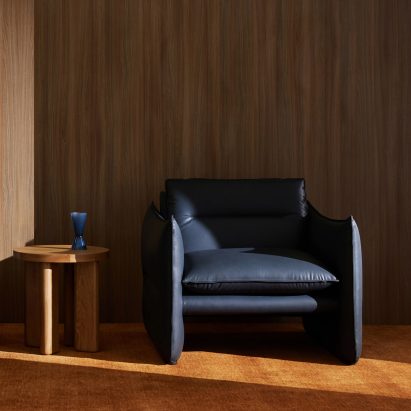
Exploring Copenhagen during this year’s edition of 3daysofdesign, it was easy to lose track of how many chairs we’d seen by the time the rain came and went and another courtyard opened its gates. Seating appeared across the Danish city in garage installations, galleries, showrooms, museum displays, and the group exhibitions that have become some of the event’s most interesting stops.
For instance, at other circle and Ukurant, emerging designers brought together pieces that felt more hand-crafted, with visible joins, unexpected proportions, and materials that still carried some friction. Elsewhere, larger presentations placed the chair inside fuller environments, using it to shape places for rest and conversation.
A polished metal frame reflected Dalmatian spots, while a blocky pine chair seemed too heavy to lift. A wave of upholstery created a fluid landscape inside Designmuseum Danmark, and a sprawling conversation pit at Vipp turned a courtyard into a place where people gathered to play.
These are the chairs that stayed with us after the fair route blurred together, each one opening up a different way to think about seating.
Bend Chair, Oberdoerfer & Krebs
At Ukurant, an exhibition of emerging designers held on the outskirts of the city, locally-based studio Oberdoerfer & Krebs’ Bend Chair and Bend Stool began with a deceptively flat premise. The pieces are formed from 3D-printed sheets, heated and shaped by hand so that the material bends only where the geometry allows it to give.
What could read as a technical exercise becomes surprisingly direct, with the chair and stool holding onto the memory of the sheet while gaining the posture of furniture. Their appeal lies in that subtle tension between control and softness, and between digital fabrication and the visible pressure of the hand.

Bend Chair, Oberdoerfer & Krebs. image © designboom
Bouquet Theory, Niko June
With its series entitled Bouquet Theory, Copenhagen-based workshop Niko June brought together found industrial fragments, old mould parts, steel profiles, and leftover components, assembling them into objects that hover between furniture and improvised still life.
Seen at other circle, the work carries the confidence of something loosely gathered rather than drawn from scratch, with each element keeping a trace of its former use. Instead of prioritizing perfection or seamless construction, the team lets roughness and accidental character shape the work’s presence in the room.

Bouquet Theory, Niko June. image © designboom
Gradas, UNS for Sancal
With Gradas, Dutch architecture studio UNS translates the stepped logic of public seating into an indoor furniture system for the Spanish furniture brand Sancal. The piece moves away from the singular chair and toward a small architecture of sitting. Here, people can perch, gather, turn, or occupy the same object in different ways.
The architects shape the stepped form to bring the language of plazas, auditoriums, and informal city edges to an individual scale, creating a social structure as much as a bench. During 3daysofdesign, it sat naturally within Sancal’s tactile living environment, where furniture acted as a spatial tool which invited play.

Gradas, UNS for Sancal. image © designboom
Poodle armChair, Mati Sipiora
Mati Sipiora’s Poodle Armchair turns a familiar type into something more animated, pairing a polished stainless steel frame with a soft upholstered seat. The tubular silhouette gives the chair its almost cartoon-like outline, while the reflective metal keeps it sharp and slightly aloof.
There is humor in the proportions, especially in the way the frame curls around the seat like a drawn line, but the object remains precise in its construction. Its softness arrives through contrast, with its patterned, Dalmatian-inspired textile set against the coolness of steel.

Poodle Armchair, Mati Sipiora. image © designboom
To Brick or not to Brick, Caspar Fischer
Caspar Fischer’s To Brick or Not to Brick approaches seating as an open-ended system rather than a fixed object. Built around a modular grid and a specially developed connection method, the project invites users to assemble and adapt their own furniture from repeatable parts.
At Ukurant, that logic gave the work a playful but architectural quality, somewhere between construction kit, domestic object, and spatial prototype. The chair becomes a prompt for participation, asking how much agency a user can have once a furniture system leaves the designer’s hands.

To Brick or not to Brick, Caspar Fischer. image © designboom
Conversation Pit, Vipp x Mesura
Inside Vipp’s Copenhagen campus, a colossal conversation pit by Danish design brand Vipp and Barcelona-based architecture studio Mesura expanded the chair into a shared landscape. During a visit to the space during 3daysofdesign, the team at Vipp tells designboom that this element of playful togetherness is a new exploration, as they’ve long curated retreats centered on relaxation in solitude.
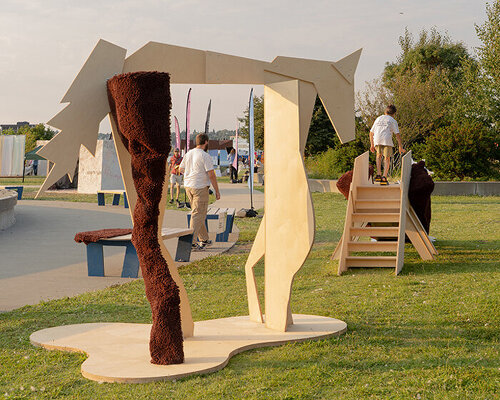
Built from sections of Vipp’s modular Loft sofa, the installation — created with Mesura — used seating to redraw the courtyard and garage as a temporary playhouse, wrapped in plaid textiles and shaped around rest, conversation, and gathering. Its strength was spatial rather than sculptural, using the low, sunken typology of the conversation pit to slow the body down and pull people toward the center of the room.

Conversation Pit, Vipp x Mesura. image courtesy Vipp
MIN Chair, Max Lamb for Hem
Max Lamb’s Min Chair for Hem is almost stubbornly reduced, built from pine posts cut on the diagonal to form the legs, back, and seat. The British furniture designer draws from an economy of material and action, where a few cuts generate the chair’s structure and its character at the same time.
Seen within the group exhibition Design Starts on Paper — which included works by Swedish acoustic brand BAUX and Swedish lighting brand BLOND — the chair made sense as a translation of drawing into solid form. It has the bluntness of a prototype, but also the clarity of an object refined until little more can be removed.

Min Chair, Max Lamb for Hem. image courtesy Hem
Welle Lounge series, Verner Panton
Verner Panton’s Welle Lounge series brought a different kind of presence to Designmuseum Danmark, where its long upholstered wave sat in conversation with the designer’s larger world of color, form, and spatial experimentation.
An undulating array of these chairs were displayed as part of the museum’s exhibition 100 Years of Verner Panton, which celebrates the 100th anniversary of the Danish designer’s birth and will be on view throughout the year.
The piece stretches seating into a soft, continuous curve, closer to a landscape than a conventional sofa. Its scale allows several bodies to share the same line without dividing the experience into separate seats. In the context of Panton’s work, the Welle series felt especially direct, turning furniture into a rhythmic surface for reclining.

Welle Lounge series, Verner Panton. image courtesy Designmuseum Danmark
Margen, Nicolai Ramm Østgaard
Casting his Margen chair in concrete, Oslo-based architect Nicolai Ramm Østgaard borrows from the proportions of the firewood log. The project begins with a simple observation: a log’s length is close to the length of a chair leg or back.
Rather than using logs themselves, Margen carries their imprint into a denser and more static material, turning an everyday measure into a heavy structural language. The concrete gives the chair a sense of resistance, as if the domestic object has been slowed down and fixed in place.
The chair showed at other circle as part of VOLUM, a group exhibition platform dedicated to contemporary Norwegian design and craft.

Margen, Nicolai Ramm Østgaard. image courtesy other circle
RAW EDGE CHAIR & METEORITE, Tatu Laakso
Tatu Laakso’s RAW EDGE CHAIR & METEORITE brings together natural live-edge wood and industrial MDF, setting two familiar materials against each other without smoothing over their differences. The small chair sits within a two-piece series that also includes a table-sized sculptural object, expanding the project beyond function into material study.
At Ukurant, the work stood out for the way it questioned carpentry’s usual hierarchies, allowing raw edge, composite board, and exposed construction to share the same surface. The chair feels direct, a little unresolved, and stronger for it.

RAW EDGE CHAIR & METEORITE, Tatu Laakso. image © designboom
project info:
event: 3daysofdesign | @3daysofdesign
dates: June 10th — 12th, 2026
The post chair-spotting in copenhagen: our favorites from 3daysofdesign appeared first on designboom | architecture & design magazine.