













‘when I go to bed, I go to work’: philippe starck on how dreams shape his creative process

philippe starck JOINS designboom’s room for dreams IN MILAN
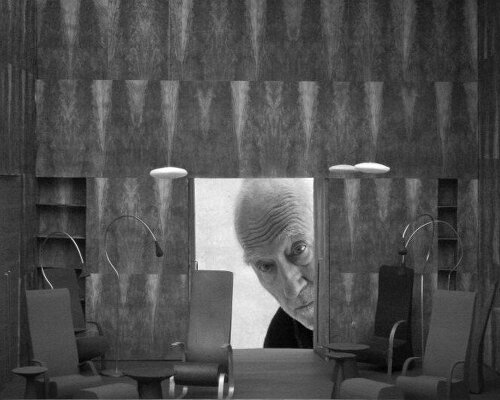
‘To speak frankly, when I go to bed, I say to my wife, I go to work,’ Philippe Starck explains to designboom’s Editor in Chief, Sofia Lekka Angelopoulou, when he joined us for a talk to kick off the social programming of ROOM FOR DREAMS during Milan Design Week 2026. The iconic French creator, known for an eclectic portfolio that ranges from the revolutionary Juicy Salif lemon squeezer for Alessi to the democratic luxury of the Ghost Chair for Kartell, describes dreaming not as a passive state of rest, but as a rigorous, active method of creation. For Starck, sleep is an alternate dimension of production where the laws of physics and the constraints of the marketplace cease to apply, allowing for the birth of unfamiliar languages and inventions.
‘When I sleep, I go to some place which doesn’t exist, with air which doesn’t exist, with vibrations that don’t exist, with people I don’t know. They speak about things I cannot understand. I see incredible inventions. I see things I cannot imagine and I have never seen in my life. It’s not a memory, it’s something else. That’s why, definitely, my dreams are more interesting than my life.’

Philippe Starck at ROOM FOR DREAMS during Milan Design Week 2026 | image © designboom, photography by Camilla Mansini with Giorgio Gagliano
A CONVERSATION ON DREAMS, INTUITION AND UTOPIAN THINKING
Under the talk’s central theme, Utopia as Method: When the Conscious Mind Dares to Dream, Starck reflects on how the subconscious has acted as the primary engine for a career defined by ‘democratic design’, the philosophy of improving quality while lowering prices to make excellence accessible to everyone. Despite his reliance on these nocturnal flashes of brilliance, Starck maintains a disciplined skepticism toward his own genius. ‘Intuition is so well done, so perfect, it feels impossible,’ he explains. ‘It cannot be so easy. That’s why I test it. I test my intuition. I test my work. It’s not about having the idea. My real work at my desk is to check my intuition.’
Through this analytical vetting process, Starck consistently finds that his initial instincts hold true. He posits that while the conscious mind is performative and prone to social curation, the dreaming mind is brutally honest. ‘Intuition comes from the subconscious, and the subconscious doesn’t lie. Consciousness lies. When I speak to you now, I lie to you. That means I try to be incredible, so that you will love me, have admiration for me. I lie. But when I dream, I cannot lie to myself.’
Starck views his cognitive process as a dualistic machine: one half fluid and instinctive, the other structural and technical. ‘My creation comes only from intuition. There are many parts of the brain. If I imagine a soft magma, like a liquid where all the ideas flow, the subconscious moves freely there. On the other side, I am an engineer. And I know how to structure my intuition, like I know how to drive my dreams. There is a part of sleep called semi-open, where you can drive your dreams. In that state, I am, wow, I am a Formula One pilot of a dream.’

Philippe Starck and Sofia Lekka Angelopoulou at ROOM FOR DREAMS | image © designboom, photography by Camilla Mansini with Giorgio Gagliano
‘Without permanent revolution, there is no utopia’
When asked whether he still believes in the possibility of a Utopia, Starck’s focus shifts toward the erosion of the concept itself. ‘The biggest problem of our society today is that there is no more utopia,’ he explains, suggesting that grand societal visions have been replaced by the shallow cycles of consumerism. ‘The only utopia I hear around me is to have more money, to have a new dress, to know what to buy, to buy, to buy—that’s the only utopia. No, we have lost the idea.’
For Starck, the failure of modern idealism is tied to a lack of sustained momentum. He links the survival of any visionary project to the necessity of constant, restless change. ‘We have lost two concepts,’ he continues. ‘We have lost the concept of utopia—to dream and to build a better world—and the concept of permanent revolution. Without permanent revolution, there is no utopia.’ He challenges the common perception that utopian projects are inherently destined to fail, placing the blame instead on human execution and social complacency. ‘When people speak about utopia, it is always about a fantastic idea that has not worked,’ Starck concludes. ‘And it is not because the idea was bad, it is because we have developed it badly.’

Juicy Salif Citrus-Squeezer, Philippe Starck for Alessi, 1990
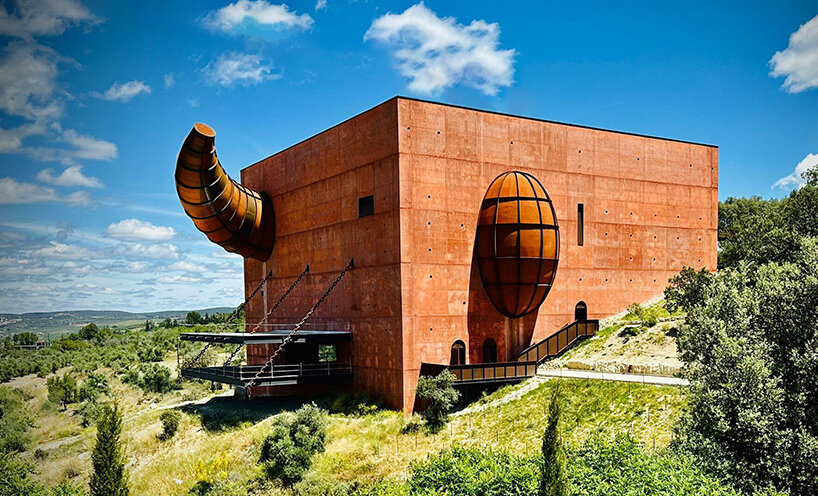
LA Almazara, Philippe Starck, Andalusia, Spain, 2024 (see more here)

Sailing Yacht A by Philippe Starck | image by Guillaume Plisson

Hotel Lily of the Valley, Philippe Starck, La Croix Valmer, France, 2019 | image © Tezenas

Heritage Rocking Armchair for Emeco

Maison Heler, Philippe Starck, Metz, France, 2025 | image © Julius Hirtzberger

AXIOM Space Station’s crew quarter habitation, Philippe Starck, 2018 | image © Philippe Starck

Villa M, Triptyque Architecture + Philippe Starck, Paris, France

A.I. Chair for Kartell, 2019

Starck portrait by James Bort
project info:
designer: Philippe Starck | @starck
This article is part of designboom’s Dreams in Motion chapter, exploring what happens when we treat our dreams and reveries as an active, radical rehearsal for impending material realities. Explore more related stories here.
The post ‘when I go to bed, I go to work’: philippe starck on how dreams shape his creative process appeared first on designboom | architecture & design magazine.