











a lattice yurt rises in milan as uzbekistan reworks traditional craft into structure

A Pavilion to celebrate craft of uzbekistan
At Palazzo Citterio during Milan Design Week 2026, the exhibition When Apricots Blossom presents Uzbekistan from street to courtyard to garden pavilion.
The project, initiated by the Uzbekistan Art and Culture Development Foundation and curated by Kulapat Yantrasast, treats craft as a working framework for architecture. The premise stays grounded in the Aral Sea region, where environmental change has reshaped both land and cultural practice, and where making remains closely tied to survival and adaptation.
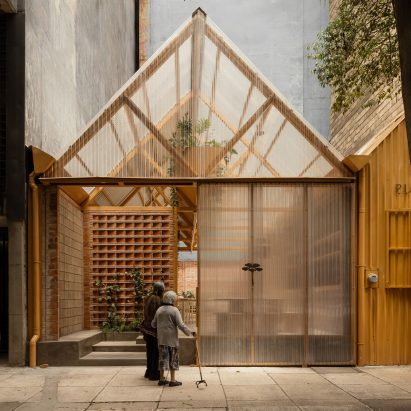
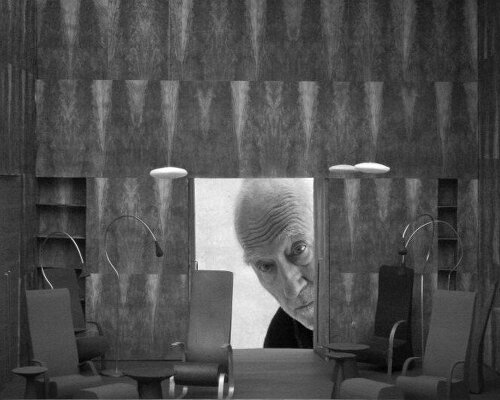
Central to the installation is a yurt-inspired pavilion, designed by wHY Architecture and built from a fine lattice and translucent skin. Its open structure filters light by day and glows at night, hosting workshops and discussions throughout Milan Design Week.

facade textiles extend craft traditions into the street | images © ACDF
Thresholds Across the City during milan design week
The first intervention of When Apricots Blossom, the Uzbekistan installation during Milan Design Week, sits directly on the facade. Long bands of woven textiles and tassels descend from upper windows, pulling color down the elevation and shifting the building’s scale. The installation reads as a soft extension of the interior outward, with strands catching light and air in a way that gives the surface a sense of movement without mechanical means.
This entry condition sets up a consistent approach to space, the exhibition uses textile, fiber, and craft techniques to define thresholds. The language comes from yurt ornamentation, yet the composition responds to the proportions of a Milanese palazzo, aligning traditional forms with a different urban context.

courtyard seating uses kurpacha to define space through use and proximity
Courtyard as Social Structure
Inside, the courtyard shifts the pace. Low seating elements based on kurpacha mattresses are arranged loosely so the space can function through occupation rather than fixed layout. Materials stay tactile and close to hand, with velvet surfaces and layered textiles reinforcing a sense of contact between body and ground.
The offering of apricot sherbet folds hospitality into the spatial sequence. It introduces a sensory layer that aligns with the exhibition’s focus on food, shelter, and clothing as parallel systems. These categories appear throughout the project, shaping how objects are placed and how visitors move between them.

a yurt-inspired pavilion by WHY Architecture forms a lightweight structure that glows at night
Reed, Light, and the Interior Field
The main gallery of the Uzbekistan pavilion during Milan Design Week is defined by a field of vertical elements. Thin reed-like rods rise from the floor to form curved enclosures, creating rooms within the larger volume. Light is held low and warm, giving the installation a dense atmosphere where objects appear gradually rather than all at once.
Within this environment, artifacts from the Aral School and related initiatives are placed on cylindrical plinths that echo the vertical rhythm of the space. The layout encourages slow circulation, with sightlines filtered through layers of material. The architecture here operates through repetition and spacing, using simple components to build a continuous interior landscape.

an apricot branch sculpture reflects cycles of cultivation and memory
Bread, Tools, and Making as Design
One section focuses on bread as both food and designed object. Traditional hand stamps, used to imprint dough with specific patterns, are presented alongside new interpretations developed by international designers working with Uzbek artisans.
The objects sit between tool and artefact. Their forms remain tied to use, yet each carries a distinct visual language shaped by material choices such as wood, ceramics, silk, or felt. The project frames these collaborations as a continuation of practice rather than a departure from it, showing how design can evolve through direct engagement with craft.

reed-like structures organize the gallery into a continuous interior field
Memory and Material Presence
Meanwhile, a sculptural installation of apricot branches is twisted and gathered into a vertical form. The piece occupies a transitional space and introduces a different register of material expression. Its structure comes from pruning remnants, giving the work a direct link to cycles of cultivation.
Nearby, the film Where the Water Ends documents residents of Karakalpakstan as they record memories tied to the disappearing sea. The film extends the exhibition beyond the gallery, connecting physical artefacts to lived experience and reinforcing the role of storytelling within the broader architectural narrative.


artifacts and research from the Aral region are embedded within the installation

project info:
name: When Apricots Blossom
architecture (yurt): WHY Architecture | @why_site
dates: April 20th — 24th, 2026
photography: © ACDF
The post a lattice yurt rises in milan as uzbekistan reworks traditional craft into structure appeared first on designboom | architecture & design magazine.