















kazakhstan pavilion turns silence into a sensory landscape at venice biennale

subtle vibrations shape Kazakhstan pavilion at venice biennale
Kazakhstan’s national pavilion at the 61st International Art Exhibition of La Biennale di Venezia unfolds as an immersive meditation on memory and sensory perception through Qoñyr: the Archive of Silence. Presented at the Museo Storico Navale near the Arsenale entrance, the exhibition marks the third participation of the country in the Biennale and a significant milestone as the first Central Asian pavilion shaped through an open call for both curator and artists. Conceived by curator Syrlybek Bekbota and featuring works by Ardak Mukanova, Anar Aubakir, Smail Bayaliyev, Oralbek Kaboke, Mansur Smagambetov, Nurbol Nurakhmet, and collective ADYR‑ASPAN, the project responds directly to the Biennale’s theme In Minor Keys by foregrounding quieter forms of knowledge and emotional resonance. Speaking with designboom, Syrlybek Bekbota describes the exhibition as an attempt to work with ‘experiences that remain unspoken, but have not disappeared,’ framing silence as a carrier of historical and bodily memory.
Rather than approaching qoñyr as a fixed definition, the pavilion positions it as a living sensibility embedded within Kazakh cosmology, sound, and landscape. While the term literally translates to brown, it also refers to tonal registers, atmospheric states, and forms of silence that hold emotional depth without articulation. ‘Initially, Qoñyr emerged as an atmosphere, as an intuitive feeling,’ Bekbota tells designboom. ‘But when we began working on the structure of the exhibition, I understood that it was not only a theme, but a way of organizing space.’ The curator transformed this notion into a spatial methodology, shaping sound, light, movement, and material through what he calls ‘the logic of inner resonance.’ Throughout the six interconnected rooms of the pavilion, visitors are invited to experience meaning through embodied attention, attuning themselves to subtle vibrations often lost within the spectacle and overstimulation of the Biennale itself.

all images ©️ Luca Girardini, 2026, courtesy of A&A Worldwide
layering sound, memory, and material presence
The exhibition begins before visitors even enter the pavilion. Across the courtyard and surrounding rooms, the sound installation Dübir by ADYR‑ASPAN overlays Venice’s ambient noise with distant horse hooves and low sonic frequencies inspired by the Kazakh steppe. For artist Gulmaral Tattibayeva, who developed the work alongside Natalya Ligay and sound artist Akmaral Mergen, qoñyr exists as ‘a special state of silence, depth, and concentration, organically inherent to the Kazakh steppe.’ Nearby, Smail Bayaliyev transforms the white cube into a tactile environment through Steppe Architectonics, an installation of monumental horse figures, felt, and steppe grass spread across the floor. ‘A work should not simply stand in a hall, it should hold the space and breathe together with it,’ he explains, describing his interest in materials that carry traces of lived experience and gradual disappearance.
Inside the pavilion, Bekbota’s own installation Aitys: The Limits of Translation introduces visitors to the improvisational traditions of Kazakh oral poetry and musical contestation. From there, the exhibition features works that trace how memory settles into domestic objects, inherited gestures, and intimate forms of mourning. In The Matrix of the New Man, Anar Aubakir exposes the worn inner lining of a camel-wool blanket inherited through generations. For the artist, the erosion of the material becomes ‘a visual embodiment of transgenerational memory.’

Steppe Architectonics by Smail Bayaliyev
where inherited histories surface through stillness
Collaborative works by Oralbek Kaboke and Mansur Smagambetov navigate inherited memory through painting, video, and installation. Kaboke’s contributions draw directly from the experiences of his parents, opening ‘a space where overlooked and unspoken histories can emerge.’ Smagambetov, meanwhile, approaches memory through what he calls ‘the audibility of childhood,’ reflecting on how historical events enter a person indirectly through daily life, habits, and emotional structures.
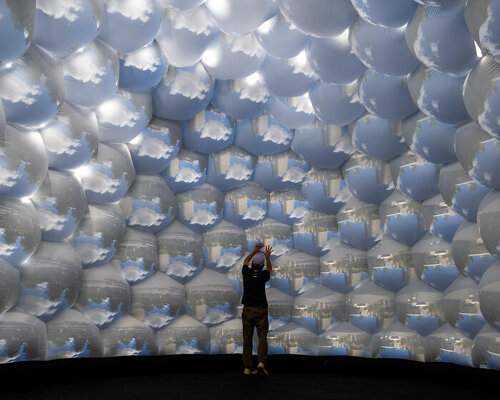
The pavilion culminates in Qoñyr Äulie: Immersion into Quiet Depths by Ardak Mukanova, a digital environment inspired by the sacred Konyr-Aulie Cave in Kazakhstan’s Abai region. The installation creates a perceptual and emotional atmosphere where myth, memory, and spirituality merge into what the artist calls ‘a quiet, calm, yet powerful space.’ Across the exhibition, this movement toward slowness and sensory immersion remains central. Bekbota explains that, against the informational overload of the Biennale, the pavilion deliberately avoids spectacle. ‘There is no attempt here to forcibly hold attention,’ he says. ‘Rather, the aim is to create conditions in which a person may want to stay longer.’

the work transforms the white cube into a tactile environment
Syrlybek Bekbota shapes an exhibition through resonance
For Syrlybek Bekbota, the curatorial logic of Qoñyr: the Archive of Silence rests in maintaining productive tensions between distinct artistic voices. ‘Between the different artistic practices, we consciously preserved a certain tension and difference,’ he tells us. The pavilion operates as what he describes as ‘a coexistence of shared statements and distinct voices,’ where sound, object, and spatial intervention remain in dialogue without dissolving into coherence. This approach also extends to the geopolitical positioning of the project. While the pavilion inevitably reflects Kazakhstan’s cultural context, Bekbota distances the exhibition from generalized notions of Central Asia, arguing that the term can sometimes impose external or even imperial frameworks onto deeply layered and distinct local realities.
Ultimately, the Pavilion of Kazakhstan at the Venice Art Biennale 2026 proposes a model of spectatorship rooted less in consumption and visibility than in attentiveness and internal resonance. ‘To transmit the Archive of Silence means to transmit not information, but a state and an experience,’ Bekbota reflects. Rather than leaving visitors with a singular interpretation, the pavilion asks them to carry fragments of atmosphere, memory, and sensation beyond the exhibition walls. If those quiet resonances continue to connect with their own experiences after leaving Venice, then, as the curator suggests, ‘the archive will continue to live.’

an installation of monumental horse figures, felt, and steppe grass spread across the floor

the artist uses materials that carry traces of lived experience and gradual disappearance

the exhibition marks the third participation of the country in the Biennale

Aitys: The Limits of Translation by Syrlybek Bekbota

navigating inherited memory through painting, video, and installation

collaborative works by Oralbek Kaboke and Mansur Smagambetov

reflecting on how historical events enter a person indirectly through daily life, habits, and emotional structures

visitors are invited to experience meaning through embodied attention

Anar Aubakir exposes the worn inner lining of a camel-wool blanket

Qoñyr Äulie: Immersion into Quiet Depths by Ardak Mukanova

a digital environment inspired by the sacred Konyr-Aulie Cave in Kazakhstan’s Abai region

the exhibition begins before visitors even enter the pavilion

Qoñyr: the Archive of Silence is presented at the Museo Storico Navale near the Arsenale entrance
project info:
name: Qoñyr: the Archive of Silence | @kazakhstan_nationalpavilion_
curator: Syrlybek Bekbota | @syrlybekbekbota
artists: Ardak Mukanova | @ardakmukanova, ADYR-ASPAN (Gulmaral Tattibayeva and Natalya Ligay), Anar Aubakir | @anar.aubakir, Smail Bayaliyev, Nurbol Nurakhmet | @nurakhmet_n, Mansur Smagambetov | @smagambetov, Oralbek Kaboke | @oralbek_kaboke
commissioner: Aida Balaeva
venue: Kazakhstan Pavilion, Museo Storico Navale, Venice, Italy
dates: May 9th – November 22nd, 2026
event: 61st International Art Exhibition – La Biennale di Venezia
The post kazakhstan pavilion turns silence into a sensory landscape at venice biennale appeared first on designboom | architecture & design magazine.